Building Compliance Obligations in Australia (Commercial Buildings)
As Responsible Authority / Facility Manager here is a list of the requirements that you need to consider when taking responsiblity for the Compliance of the Facilities that you own/operate/care for.
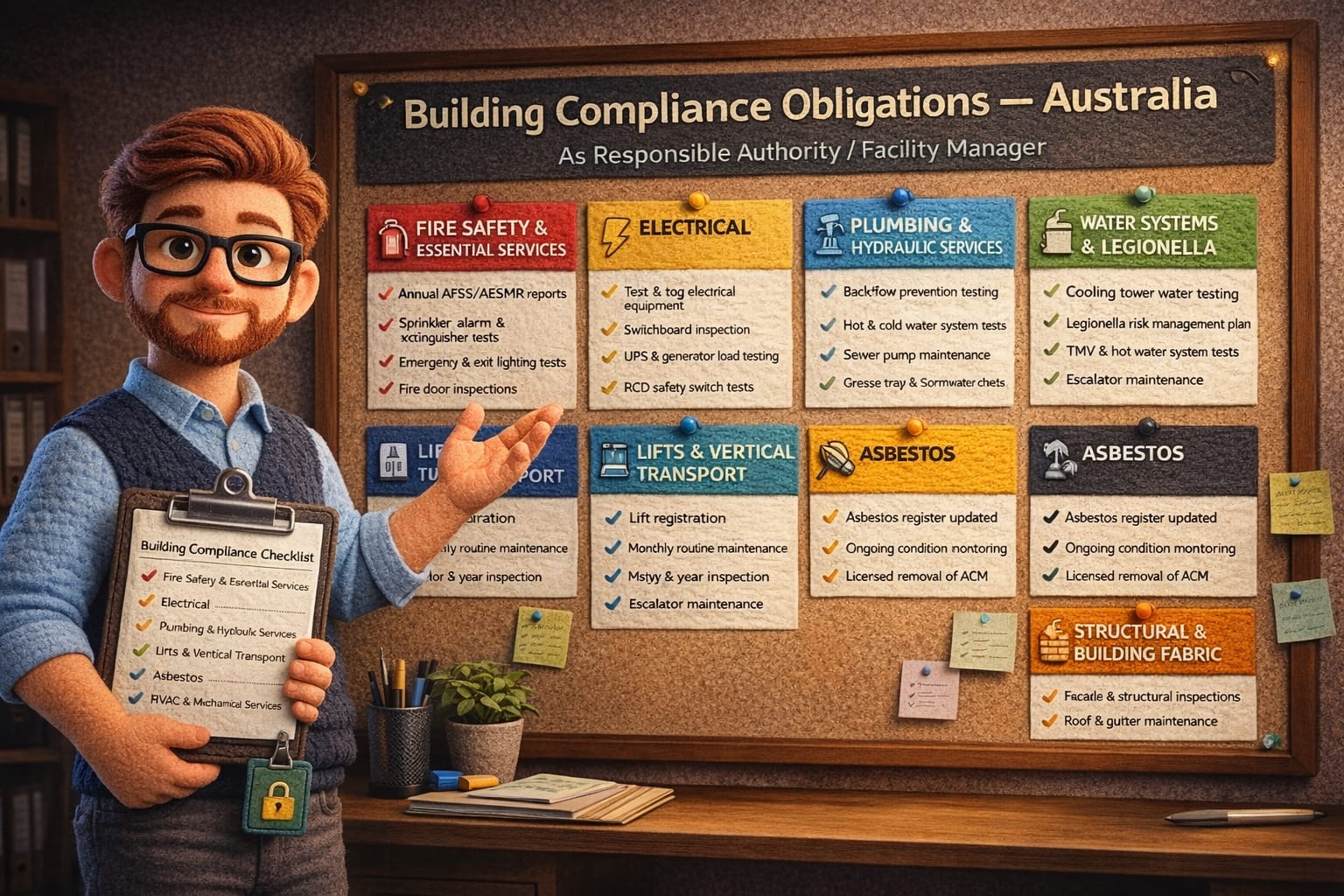
Note: This list may not be complete and/or may change from time to time.
🔴 FIRE SAFETY & ESSENTIAL SERVICES
The most legally enforced category. Non-compliance carries significant fines.
| Obligation | Frequency | Governing Standard/Legislation |
|---|---|---|
| Annual Fire Safety Statement (AFSS) | Annually | EP&A Regulation 2021 (NSW); equivalent in each state |
| Essential Safety Measures Report (AESMR) | Annually | Building Regulations 2018 Pt.15 (VIC) |
| Fire detection & alarm system testing | 6-monthly / annually | AS 1851-2012 |
| Fire sprinkler system maintenance | Monthly checks / annual full test | AS 1851-2012 |
| Fire hydrant & hose reel pressure testing | Annually (6-monthly checks) | AS 1851-2012 |
| Fire extinguisher inspection & service | 6-monthly; pressure test every 5 years | AS 1851-2012 |
| Emergency & exit lighting test | 6-monthly discharge test; annual survey | AS 2293 |
| Fire door inspections | Annually | AS 1905; NCC |
| Passive fire protection (penetrations, seals, dampers) | Annually | BCA / NCC |
| Evacuation plans & emergency procedures | Annually reviewed | AS 3745-2010 |
| Smoke alarm testing | Per maintenance schedule | AS 1670 |
| Occupancy permit on display | Ongoing | Building Act (state-specific) |
Penalties for non-compliance in NSW include fines of $33,000 for individuals and $66,000 for corporations. NSW Government
🟡 ELECTRICAL
| Obligation | Frequency | Standard |
|---|---|---|
| Electrical installation inspection & testing (Test & Tag) | 12–24 months depending on risk | AS/NZS 3760 |
| Switchboard inspection | Every 5 years (minimum) | AS/NZS 3000 |
| Thermographic (thermal imaging) survey of switchboards | Every 2 years recommended | AS/NZS 3000 |
| Certificate of Compliance – Electrical Work (CCEW) | After each electrical installation | State-based Fair Trading/Energy Safety |
| Uninterruptible Power Supply (UPS) testing | Annually | Manufacturer/AS standards |
| Generator load testing | Annually | AS 2789 |
| Safety switches (RCDs) test | Every 2 years (some states annually) | AS/NZS 3760 |
🔵 PLUMBING & HYDRAULIC SERVICES
| Obligation | Frequency | Standard/Legislation |
|---|---|---|
| Backflow prevention / RPZ valve testing | Annually (mandatory) | AS 3500; state plumbing regulations |
| Hot & cold water system inspection | Annually | AS 3500 |
| Drainage inspection (CCTV survey) | Every 3–5 years | AS 3500 |
| Stormwater management inspection | Annually | State EPA / council |
| Grease trap service (where applicable) | Quarterly / per council requirement | Local council |
| Sewage pump maintenance | Annually | AS 3500 |
Overdue or failed RPZ backflow prevention valves can result in immediate compliance notices from authorities.
🟠 LIFTS & VERTICAL TRANSPORT
| Obligation | Frequency | Standard/Legislation |
|---|---|---|
| Lift registration & certification | Annually | State Work Health & Safety legislation |
| Lift routine maintenance & logbook | Monthly | AS 1735 |
| Major periodic inspection | Every 5 years (or as directed) | AS 1735; state regulator |
| Escalator & moving walkway maintenance | Monthly | AS 1735 |
In both NSW and Victoria, lift compliance failures commonly trigger improvement notices, prohibition notices and insurance complications.
🟢 WATER SYSTEMS & LEGIONELLA
One of the fastest-growing enforcement areas in Australian commercial buildings.
| Obligation | Frequency | Standard/Legislation |
|---|---|---|
| Cooling tower registration | Ongoing (registration required) | Public Health Act (state-based) |
| Cooling tower water treatment & testing | Monthly sampling minimum | AS 3666; state public health regulations |
| Cooling tower risk management plan | Reviewed annually | AS 3666-2011 |
| Legionella water sampling & reporting | Quarterly minimum | State Public Health legislation |
| Thermostatic mixing valve (TMV) testing | Annually | AS 4032; state health dept guidelines |
| Hot water system temperature compliance (>60°C storage) | Ongoing monitoring | AS 3500; state guidelines |
In Sydney and Melbourne, enforcement action following Legionella incidents is increasing, particularly where records are incomplete or responsibilities are unclear.
⚫ ASBESTOS
| Obligation | Frequency | Standard/Legislation |
|---|---|---|
| Asbestos Register (buildings pre-2004) | Reviewed every 5 years (NSW); annually reviewed (VIC) | WHS Act & Regulations (national) |
| Asbestos Management Plan | Updated when conditions change | WHS Regulations |
| Asbestos condition monitoring | Per risk assessment / annually | Safe Work Australia Code of Practice |
| Licensed removal (if disturbed or degraded) | As required | WHS Regulations (Class A/B licence) |
Under workplace health and safety laws, commercial properties built before 2004 must have an up-to-date Asbestos Register that is reviewed and updated at least every five years in NSW.
🟣 HVAC & MECHANICAL SERVICES
| Obligation | Frequency | Standard |
|---|---|---|
| HVAC routine service & filter replacement | Quarterly | AS 1668; NCC |
| Ventilation system performance test | Annually | AS 1668-2012 |
| Air quality testing (CO₂, fresh air) | Annually (or where complaints raised) | ASHRAE 62.1; AS 1668 |
| Car park ventilation system test | Annually | AS 1668 |
| Kitchen exhaust system cleaning | Every 3–6 months | AS 1668; AS/NZS 1680 |
| BMS (Building Management System) calibration | Annually | Manufacturer / NCC |
🔶 STRUCTURAL & BUILDING FABRIC
| Obligation | Frequency | Standard/Legislation |
|---|---|---|
| Building façade / cladding inspection | Every 5 years recommended | NCC; state building authority guidance |
| Roof condition inspection | Every 2–3 years | NCC |
| Structural inspection (post-event or programmed) | As required / after major storms | NCC |
| Anchor points & fall arrest systems certification | Annually | AS/NZS 1891 |
| Car park structural inspection | Every 5 years | NCC / engineering standard |
⚪ ACCESSIBILITY & PREMISES STANDARDS
| Obligation | Frequency | Standard/Legislation |
|---|---|---|
| DDA compliance audit | Upon change of use / as required | Disability (Access to Premises — Buildings) Standards 2010 |
| Accessible path of travel maintenance | Ongoing | NCC / Premises Standards |
🟤 WORKPLACE HEALTH & SAFETY (WHS)
| Obligation | Frequency | Legislation |
|---|---|---|
| WHS risk assessments | Annually + after incidents | WHS Act (national/state) |
| Hazardous materials register | Maintained & reviewed annually | WHS Regulations |
| Emergency response plan & evacuation drills | Annually minimum | AS 3745-2010 |
| First aid kit inspection | Every 12 months | WHS Regulations |
| Plant & equipment registration (where applicable) | Per registration period | WHS Regulations |
| Workplace incident reporting | Ongoing (notifiable incidents immediately) | WHS Act |
⚡ ENERGY & SUSTAINABILITY (GROWING OBLIGATIONS)
| Obligation | Frequency | Standard/Legislation |
|---|---|---|
| NABERS energy rating (commercial tenancies >1000m²) | Annually (mandatory for large buildings) | Building Energy Efficiency Disclosure Act 2010 |
| Energy Efficiency Disclosure (BEED Act) | At point of lease/sale | BEED Act 2010 (Federal) |
| Gas & electrical sub-metering (NCC 2022+) | Ongoing monitoring | NCC 2022 Section J |
| EV charging infrastructure readiness (NCC 2022) | New builds / major refurbs | NCC 2022 |
Important Notes
State variation is real. The core obligations above apply nationally, but the reporting forms, enforcement bodies, and specific frequencies vary by state. The key regulators are:
- NSW: NSW Building Commission, Fair Trading, SafeWork NSW, NSW Health
- VIC: Building & Plumbing Commission (replaced VBA July 2025), WorkSafe VIC, VIC Health
- QLD: QBCC, Workplace Health & Safety QLD, QLD Health
- WA: Building Commission WA, WorkSafe WA
- SA/TAS/ACT/NT: State-equivalent bodies
Liability cannot be transferred. Building owners remain legally responsible even when hiring facility managers or maintenance contractors, you cannot transfer this legal liability through contracts. As an FM company acting as responsible authority, you are the documented duty holder.
Records are as important as the work itself. Building owners are legally required to keep accurate maintenance logs and be able to present ESM records within 24 hours upon request. The compliance isn't just about doing the work, it's about being able to prove it.