
You'll have 24 hours to produce ESM records. Most operators can't do it in 24 days.
Victoria's new Building and Plumbing Commission (BPC) has been in force since 1 July 2025. The operational consequence has not landed for most facility managers and building owners yet.
It will.
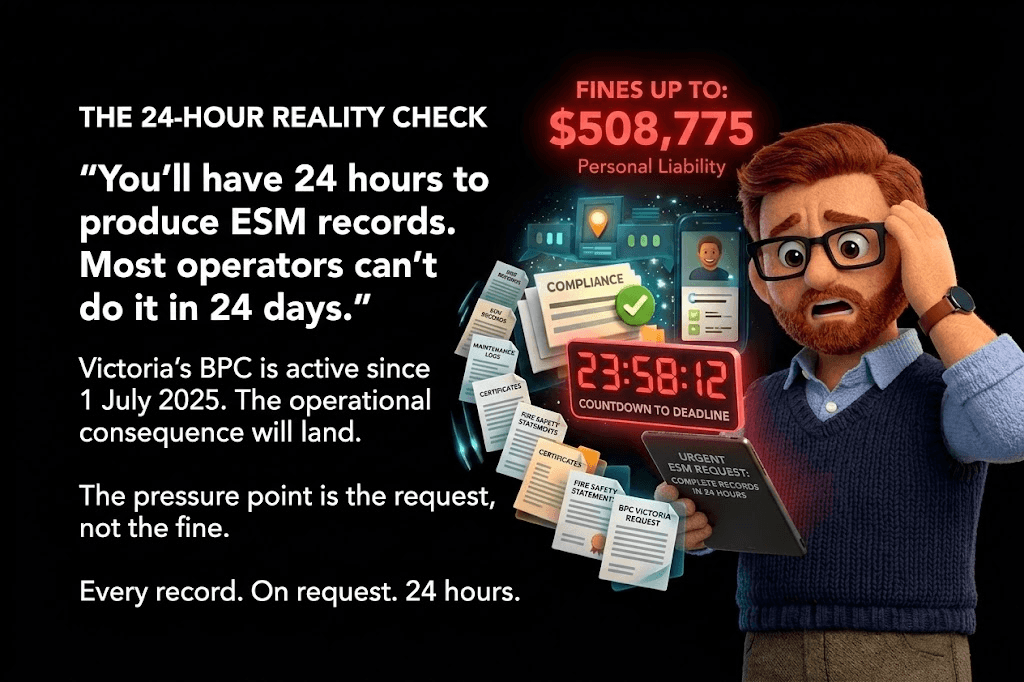
Magistrates' Court prosecution for serious Essential Safety Measures breaches now carries fines up to $101,755 for individuals and $508,775 for corporations. The Building and Plumbing Administration and Enforcement Bill 2026, introduced earlier this year, gives the BPC broader infringement powers, new improvement notices, civil penalties, and the ability to make directors personally liable.
But the headline fine is not the pressure point.
The pressure point is what the regulator can ask for, and how long you have to find it.
24 hours. Every record. On request.
Under the current regime, the BPC, municipal building surveyors, and Fire Rescue Victoria can request all of your ESM documentation with 24 hours' notice. You must produce it within that window.
"All of it" is not a small list:
- The current Annual Essential Safety Measures Report (AESMR)
- Every AESMR from the previous 10 years
- Maintenance schedules and maintenance determinations
- Records of every inspection, test, maintenance event, and repair across the entire ESM register
For a single mid-rise commercial building, that's hundreds of records a year. For a portfolio operator, multiply that by every site, every measure, every standard (AS 1851 for fire protection systems, AS 2293.2 for emergency lighting, and the rest of the stack). The entire ESM asset register, with full service history attached.
24 hours to produce it.
In the real world, most operators couldn't pull it together in 24 days.
The records exist. They just don't live where they need to.
This is the part everyone in commercial property services already knows but rarely says out loud.
The fire hydrant flow test report is in a PDF on a tech's tablet that synced to a cloud the building owner can't access. The 90-minute battery discharge test from three years ago is in a spreadsheet maintained by a contractor who lost the panel last tender round and walked away with the historical data. The monthly fire pump operational test results live in a job management platform that the building owner has never logged into.
When contracts roll over, records don't transfer cleanly. When techs leave the contractor, knowledge walks. When the building changes hands, the new owner inherits the compliance liability without inheriting the evidence trail.
The regulator does not care whose system the record sits in. They care that you produce it in 24 hours.
The fix is upstream, not downstream
You cannot solve a 24-hour production requirement by getting better at chasing contractors after the fact. You solve it by changing where the record is created in the first place.
ESM work is field work. The technician is on site, doing the inspection, the test, the service. The record gets made there. The only real question is: does that record land in your system, or in theirs?
If it lands in theirs, you are dependent on the goodwill and tenure of every contractor across your portfolio to maintain a defensible compliance position. That is not a system. That is hope.
If it lands in yours, the contractor still does the work, but the evidence trail belongs to the building, not the vendor. Contracts can end. Techs can move on. Service providers can change. The record stays.
What this looks like in Eaco
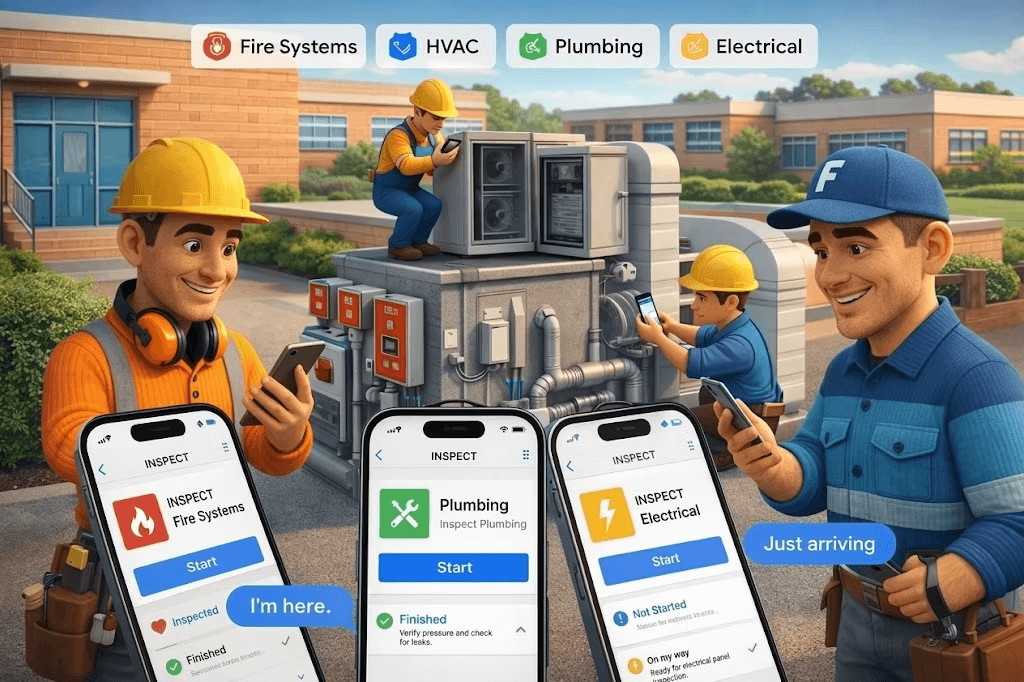
Eaco Forms is the field record layer. Every ESM inspection, test, service, and repair is captured against the asset, the building, and the date, with photos, signatures, technician, and timestamp.
The contractor keeps their own scheduling and dispatch. They just complete the form in Eaco for the work they are already doing on your site.
Here's what a regulator request looks like in practice. An auditor asks for the last 12 months of fire hydrant flow tests at a specific site. The maintenance log surfaces, filtered by asset, dated, with the technician and the result attached.
Not 24 days. Not 24 hours. Seconds.
The compliance trigger is the wedge. The platform is the win.
ESM is the obvious entry point because the regulatory clock is loud and the fines are large. But the same record layer covers every other compliance obligation in the building: contractor inductions, SWMS, asbestos registers, hazard reports, incident logs, periodic inspections, the lot.
Once the building owns the record, the rest of the compliance stack consolidates around it. The contractor relationships stay intact. The evidence trail moves under your roof, where it should have been all along.
The 24-hour rule is doing the work for us. The only question for every building owner and FM in Victoria is whether they want to find that out from a regulator, or from a system that's already ready.
Learn more
- Eaco Compliance Management: track certifications, insurance, audits, and safety records in one auditable layer.
- Eaco Asset Management: one source of truth for every asset, with inspection history, lifecycle tracking, and document storage.
- Eaco Facility Management: the full FM stack from asset register to maintenance scheduling to contractor coordination.
Eaco is the compliance and coordination layer for commercial property services across Australia and New Zealand. If you manage ESM obligations across a portfolio and want to see what a 24-hour audit request looks like in seconds rather than days, get in touch.