Interview with Eaco's Founder: Why "Boring" Businesses are Where the Smart Money Hides --> The Hidden Cash Flow Machines in Plain Sight
Most people look at commercial cleaning or facility management and see a low-margin, unglamorous grind. They see mops, maintenance schedules, and old-school operators who still use filing cabinets.
I look at it and see a highly profitable cash machine hiding in plain sight.
I recently sat down with Jamie Spense on the Private n Listed Podcast to unpack exactly how I’ve built, scaled, and modernised these "boring" baby boomer businesses. For the last 20 years, my focus has been on dragging fragmented, traditional industries into the modern world.
What I’ve learned is that if you are trying to scale an old-school operation today, you are probably playing by the wrong rules. To unlock exponential growth, you have to stop thinking like a traditional operator and start thinking like a tech founder.
Here are three mental models that change the game entirely.
Listen to this podcast on:
Spotify
https://open.spotify.com/episode/5VfRBu6zHFCGlbXIOUPCHQ
Apple Podcasts
Amazon Music
1. The Subscription-ification of Blue-Collar Work
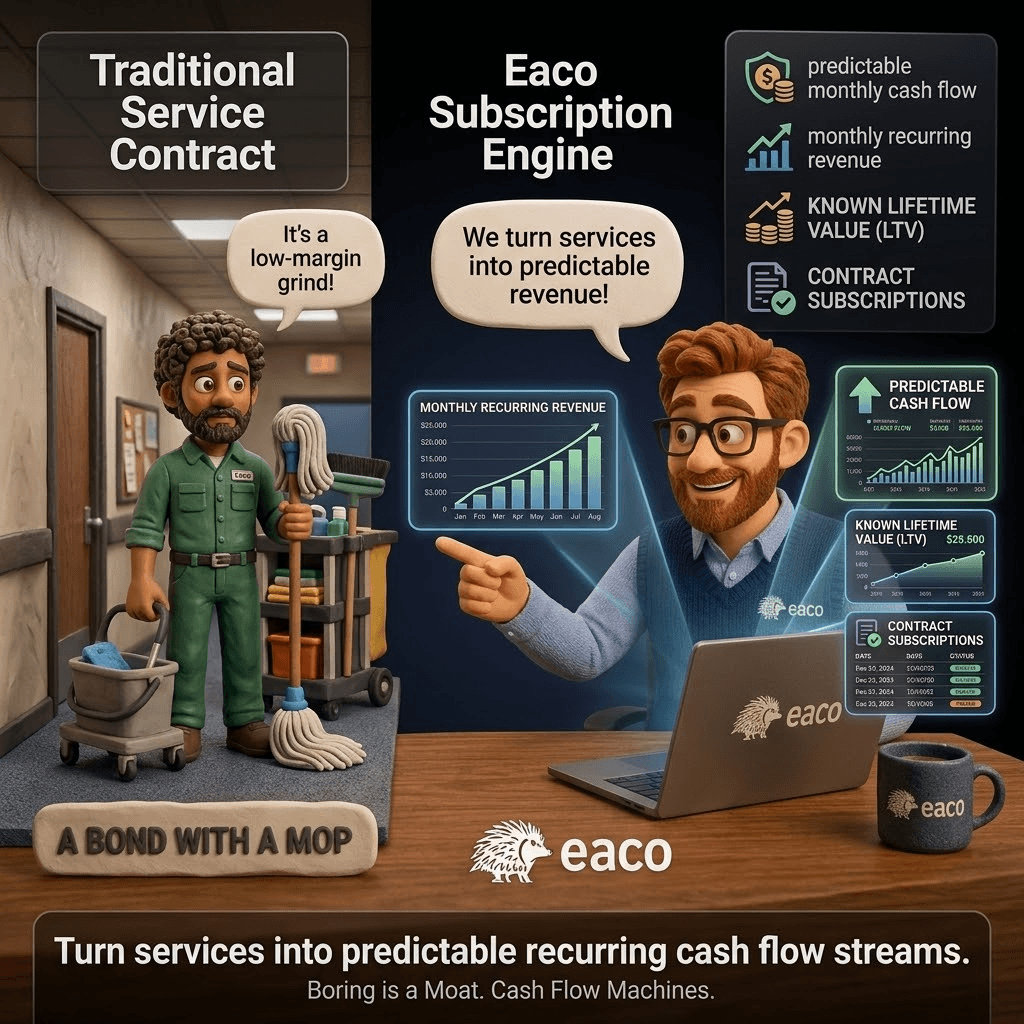
Tech investors are obsessed with software subscriptions because of the recurring revenue. You sell the product once, and the cash flows in every single month.
But if you look closely, a 5-year facility maintenance or commercial cleaning contract operates on the exact same mechanics. It is basically a bond with a mop.
- You have an upfront capital cost: The time and money spent tendering and winning the contract is your Cost of Customer Acquisition.
- You have a known lifetime value: Once signed, you know exactly what that contract is worth over its lifespan.
- You have predictable monthly cash flow: Just like a software subscription.
When you stop treating your traditional business like a one-off trade and start treating it like a recurring revenue engine, your margins and your multiples explode. The goal isn't just to fulfill the contract; it's to optimise the operational delivery so that your margin expands month over month.
2. The Tech-Enabled Pub (Silicon Valley Unit Economics)
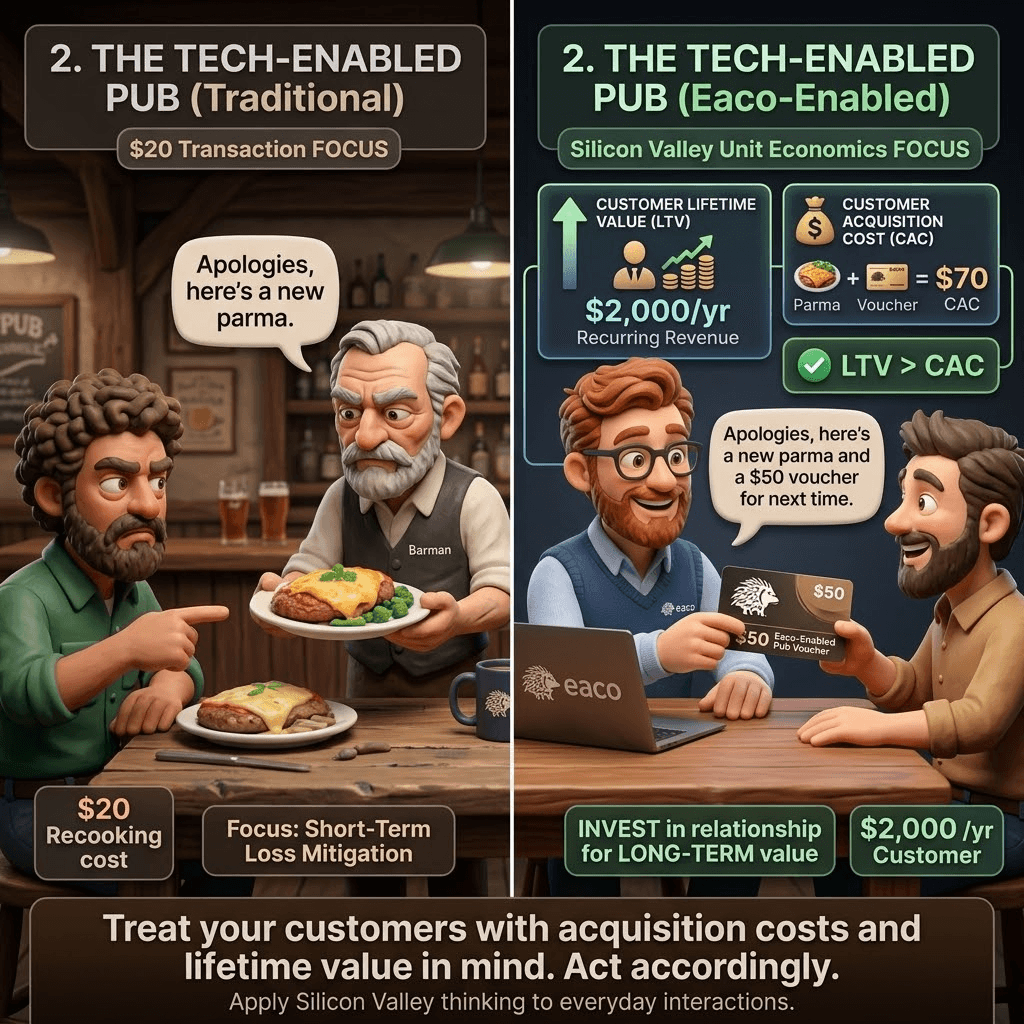
To make this model work, you have to apply Silicon Valley unit economics to everyday customer interactions.
When I took over a historic pub in the Grampians, I brought this tech-centric thinking into the hospitality world. During our first few weeks, a customer sent back an undercooked $20 chicken parma.
The traditional hospitality response? Apologise and cook them a new one.
My response? Give them a new parma and hand them a $50 voucher.
My staff thought I had lost the plot. Why give away $50 over a $20 meal? Because I wasn't looking at a $20 transaction. I was looking at a customer's lifetime value. If that guy likes us and trusts us, he comes back week after week. He is a $2,000-a-year recurring revenue stream. If we argue over a piece of chicken, we lose $2,000 to save $20.
Whether you are running a pub, a cleaning crew, or a massive facilities network, you have to treat your customers with acquisition costs and lifetime value in mind. Act accordingly.
3. Complexity Creates Chaos (The Uber-ification Rule)
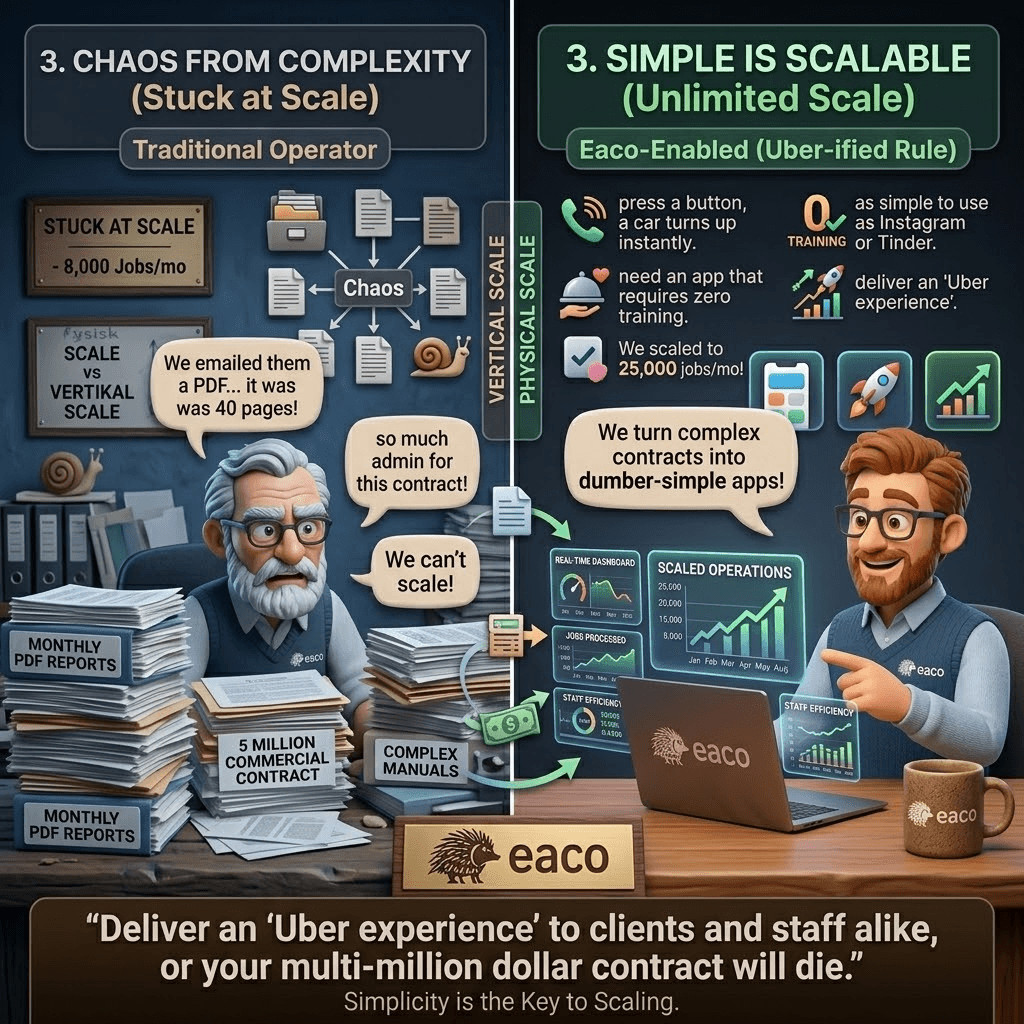
The bigger an organisation gets, the dumber-simple it has to become.
We live in a world where consumers can take out their phone, press a button, and a car turns up instantly. They press another button, and their dinner arrives. Yet, when these exact same people go to work and sign a $5 million commercial contract, traditional operators expect them to be satisfied with a PDF report emailed once a month.
Those days are over. Today, a multi-million dollar contract lives or dies on whether you can deliver an "Uber experience."
Your clients expect a real-time dashboard. Your front-line workers—whether they are a 55-year-old cleaner or a 25-year-old casual—need an app that requires zero training to use. To scale a fragmented business, your operational software has to be as simple to use as Instagram or Tinder.
When we built the Eaco platform, we obsessed over this simplicity. It’s exactly how we helped a client scale their operations from 8,000 to 25,000 job requests a month—without hiring a single extra person for their head office.
Boring is a Moat
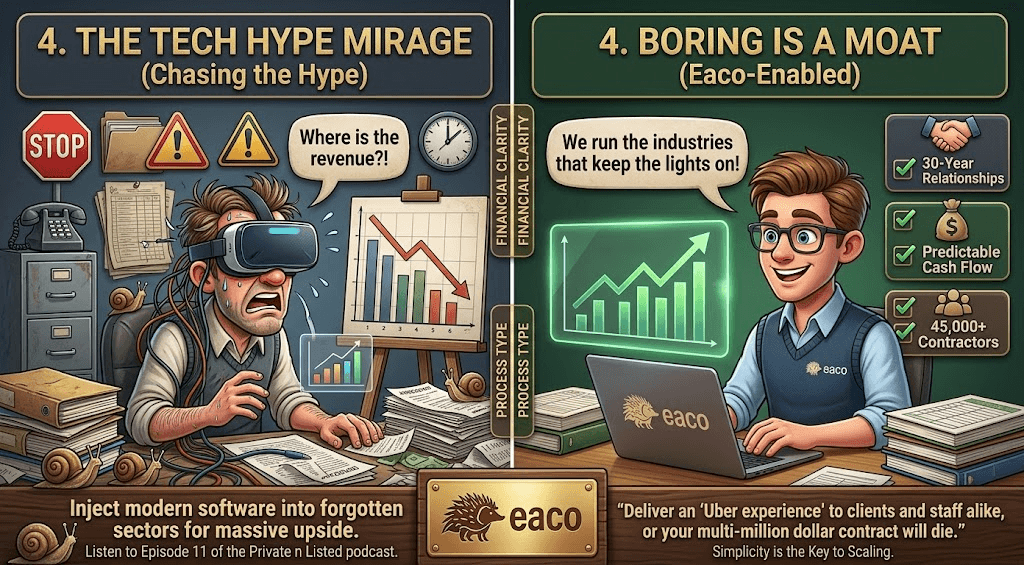
Everyone right now is racing to build the next sexy AI app. Let them.
I'd rather own the operating system for the industries that actually keep the lights on. Boring businesses come with 30-year customer relationships, deep moats, and cash flow for days. When you inject modern software, operational excellence, and a recurring-revenue mindset into these forgotten sectors, the upside is massive.
If you want the full blueprint on how we brought 45,000 contractors onto the internet and the exact methodologies we use to scale traditional businesses, check out Episode 11 of the Private n Listed podcast.
Speak to the Founder of Eaco today.
Discover how Eaco empowers businesses to simplify operations, strengthen compliance, improve visibility, and deliver better outcomes. Book a demo today by visiting eaco.me, calling us directly at 1300 422 626 or connecting on LInkedin here: https://www.linkedin.com/in/dan-ahchow/
Love to Read? Here is the full interview transcript
Private n Listed Podcast: Episode 11
Host: Jamie
Guest: Dan Ahchow, Founder of Eaco
Jamie: Good morning everybody, welcome to episode 11 of Private n Listed. Today, I've been looking forward to this for quite a while. My guest is Dan Ahchow. Dan is in the real context of entrepreneur across Australia. We use the term lightly, but Dan is. He built businesses across software, services, hospitality, and regional assets, and I'm sure you'll enjoy what we unpack in this episode. He also is dear to my heart because a lot of the software operational innovations that he brings to the market are in the under-appreciated baby boomer industry. And as you all know, I talk about how difficult it is in previous episodes for baby boomers to transition and exit their business. It's a succession-driven industry, but Dan will delve into that when we go through. But look, thanks for joining the podcast, Dan, I really appreciate having you on.
Dan: Thanks for having me Jamie, and what an intro! Wow, hopefully I live up to the hype.
Jamie: Well you do because you've crossed a number of businesses and a lot of entrepreneurs, you know, they're great, but they stick to one specific industry. You've done something that I think is just truly difficult, amazing, and you've carried it off with aplomb. So let me start, what first pulled you into entrepreneurship?
Dan: It was my parents, actually. So my dad had a government job in the 1980s, he was actually working for the railways, and he didn't feel like it was very stable. He had three young kids, and so him and mom started a cleaning company. Within 10 years they had grown that from nothing to over 300 employees. So these were during my formative years where I could see the real positive impact of a family business and I caught the bug, I guess.
Jamie: Good on you. Was there a moment when you realized that software could be used to drive operational change in businesses? I mean, that's a segue from what you were doing with the family business.
Dan: Yeah, so I was at law school and then I ended up as an industrial relations lawyer at RACV. There I ended up on a project to identify the best contractors. They had 600 contractors representing RACV, roadside assistance and the like, and they wanted to reward the good ones and get rid of the not-so-good ones, I guess. So coming from that legal background, I was like, "Well, we'll just stitch them up with a contract. That's the way to do it." But instead, they took me down into the dungeons of RACV—gee, that sounded dark, but they took me down into the dungeons of RACV where the filing cabinets were, they dusted off these thick contracts and said, "Dan, no one ever looks at a contract after it's signed. We need to find another solution."
And then that's when I looked to the internet to see what was happening on the internet. This was 2001 when eBay was popular and buyers and sellers were rating each other. And I said, "How about we use technology? How about we use this internet thing to start rating the good providers and the poor providers as well, and then we can identify which are which?" They thought that was the dumbest idea in the world. I thought it was a good idea, and that's where my passion for technology and software and how it can make the world a better place came to be.
Jamie: Thank you. Before we get into Ecosystems, which is what you are now the founder of and is across predominantly facilities management, you did something pretty exciting. You founded a business called Service Central. Can you talk a bit about how you got into that, and what did you learn from scaling it? It's a great success story, so go for your life here.
Dan: Yeah, well that idea from RACV really sparked something in me. And I'm like, "How do we identify the best businesses in Australia and how do we help them match with consumers?" So in 2005, along with my father, I launched Service Central, which was Australia's first marketplace for services. It was an easy way to find tradies and local service providers. You say what you want, and then up to three businesses could come and quote on that work, and that was all instantaneously matched. We ended up building that to a network of over 45,000 businesses across Australia, and over the 10 years that I ran it, we generated over $2 billion worth of work opportunities for those businesses.
Jamie: That's real scale. And did you know at the time when you started out that it was a goal you had in mind? I mean, that's value for all the people that used it because it allowed them to get and look up what they wanted quickly.
Dan: Yeah, it was interesting. It was more of "this is something that the world should have, why doesn't the world have this?" and bringing it to market. And then all of a sudden that idea grew and grew and grew. So it went from an idea that I had in my early 20s to a fully-fledged business. We ended up raising over $10 million from some very sophisticated investors, grew to up to 100 staff, onboarding the network of 45,000 trades and services businesses and the like. So yeah, it went from it was about "what is required to bring this to the world? Like, the world needs this, and what do we have to do to actually make it happen?"
Jamie: Yeah, what was the hardest part of building a platform like that that actually changed how businesses operate? I mean, it sounds simple, but no one else had done it until Service Central was created. So what was the hardest part?
Dan: Ah [laughs], I guess that's part of the fun of being an entrepreneur, right? That you have to be good at a lot of things simultaneously. You have to be good enough to build the technology, you have to be good enough at marketing and communicating your message to generate thousands of opportunities for our clients. You have to be good enough at understanding financial statements to take responsibility for your investors. You have to be good enough at attracting the best people to come and work for you. And then you have to be—you have to have that juggling act of orchestrating all of those things at once. So yeah, that's all. Just bringing all those elements together, that's all that's required to make it happen.
Jamie: Are you the type of person that socializes your ideas with your friends or your family or trusted advisors, or do you make these decisions yourself?
Dan: Ah, that's a good question Jamie. I do remember when I was before Service Central launched, my girlfriend at the time, whenever anyone would ask me, "What are you doing Dan? What are you doing?" and she'd just roll her eyes. It was very, very difficult to communicate these abstract concepts. So it was more so a matter of "show, don't tell," and that's how I've sort of operated since. That let's—yeah, let's not try and tell people what we're creating. Let's just show them, let them experience it, and then at that point, they have the aha moment of "Wow, this is really cool."
Jamie: I think in anything that we talk about in life, proof of concept is everything. It doesn't matter whether it's visual or hands-on or makes things more efficient, it is proof of concept. So that's great, thank you. Was there a time when you realized that software could be used for operational change in businesses? And if so, what led you from service businesses to building Eaco?
Dan: Um, so what led us to building Eaco—or as a platform that was available to others. So effectively we'd created this platform that enabled us to service our customers. The hundreds of thousands of consumers that would come to Service Central and the 45,000 businesses that we had qualified and ensured and made sure that they were trustworthy people that we were happy to have others use.
Then what we started to see, enterprises, insurance companies, government organizations, government departments, facility management companies that saw what we were doing, saw that it was genuinely unique, and wanted to understand how we were doing that, how we'd scaled so quickly, how we'd done it as such a high-quality service provider and the like. And those inquiries kept on coming in and in and in.
I was like, "Okay, I'm going to take two of our best developers, set them aside for a year, and build a platform that not only managed our business but was flexible enough to manage other businesses, other major organizations across a lot of different sectors and industries." So yeah, that's how Eaco came to be. It was born out of that desire for people to understand how Service Central worked and then apply that to their own organizations.
And the cool thing about that was that we were running—we were running so lean, so efficient, so capital efficient. I remember when a large—or the largest privately owned roadside assistance network came to us and they had 40 staff in their call center and they were managing probably, I don't know, 6 or 8,000 requests a month. And they came to our office to see how we operated. And we had—we were generating a similar sort of number of jobs, we had 8,000 job requests a month that we were managing, and we had one admin person. And they said, "Wow, like how are we doing this? Like, let's start working together." And we ended up working together for the next 6, 7 years until they had scaled up to 25,000 roadside assistance jobs per month, and their team was the same. They had scaled their business three or fourfold and had the same 40 people in their head office. So that was fun.
Jamie: Looking back at it now, because I've known you for a while, a mutual friend of ours introduced us to each other in Melbourne... I understand in my mind the segue from Service Central to Ecosystems. But can you please tell the listeners what Ecosystem does and how that from a software perspective enhances facilities management companies?
Dan: Yeah, so we view it as an operations management platform for providing excellent service to your clients and making it a very efficient and effective business as a whole. So that touches every element of your business. Excellence isn't just one thing, you actually have to tie together all the different elements.
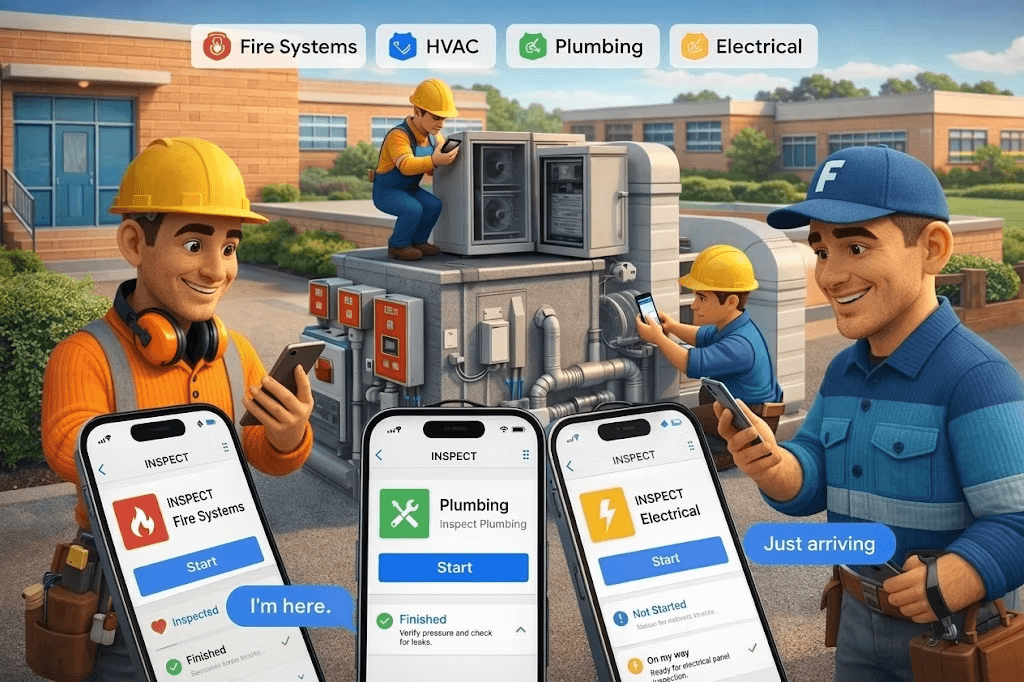
So it started out with compliance management of contractor bases. People wanted to access our contractor network, but then they also wanted to build their own network of trusted contractors. So we helped them build that platform—or build that network—and make sure that they were all qualified, insured, trustworthy, compliant, and the like. That led to works management and managing the work orders and the like, and then it led to safety and making sure that all the work was done safely. Then it was led to ensuring that the works were done properly and that there was appropriate artifacts to ensure that they had proof of delivery. And then that took us right into the finance: how to manage contractor invoices, how to bill clients, and then clients wanted client portals, and now we have real-time chat with clients and the like. So it's—if you could imagine taking an old-school baby boomer business and turning it into an Uber for your industry, that's what Eaco does. It's about creating an amazing experience for both you, your clients, your staff, and your contractors. And then most recently we've expanded into some very large commercial cleaning companies with 500+ staff and it's about applying those learnings to cleaning, which is more about rostering and scheduling and time and attendance and timesheets and the like, which we've been very, very successful at.
Jamie: I'm passionate about this industry as you know from helping people buy and sell baby boomer businesses, and often not glamorous—they're in this facilities management industry is exactly fits exactly in that boat. And there are a lot of them in Australia. What do you think makes this industry compelling to scale?
Dan: Okay, so um, I've hung out with a lot of tech entrepreneurs and they always talk about how SaaS is such a good business model. And the whole concept of SaaS is that it's not a one-off sale, it's you sell them a software and every month this revenue comes in. And having come from the background of my parents growing up—well, my parents with their cleaning company—I'm like, "This is really, really similar to the cleaning company." You win a contract and then month in, month out, you get paid for that service.
So I don't know about you Jamie, but I actually think that the more you look into it, the more parallels there are between these modern unique tech companies and, you know, your boring traditional baby boomer businesses. And you know for a fact that they've got to be good businesses, because these guys—these guys have created and held onto these businesses for 30 or 40 years. You don't do that unless they're a good business.
Jamie: Well I think you had insight in when you had a cleaning business with your family when you were young, so you do know the ins and outs of it. But essentially it's a super competitive industry with a lot of tendering going on. Incumbents usually get invited back, but it's often a low-margin business. And it's not—it's not a sexy business, right? It's something that it's cash flow generating, and when it's done well you can see it. You can walk into a Westfield or a shopping center and you can say, "Wow, that's well cleaned," right? Or a school. But I noticed when COVID came in, I mentioned in one of the earlier episodes that the lowest common denominator always comes in and people wanted to say, "Oh, I can do cleaning." And for a while businesses took on the cheaper pricing, but then after COVID finished they realized, "My business is not cleaned as well as it needs to be," and they went back to the original cleaning providers. But it's a massive industry across Australia. And I've got to guess that when you're talking to a client or a new client, the amount of time that you can save them by putting them onto the Eaco operational platform allows them to get on with what they want to do, which is talk to their staff, their contractors, clients, and start tendering for new projects. So I feel it's a compelling industry to scale. What do you think? What kind of operational tech matters in aging and this type of baby boomer industry?
Dan: Yeah, you covered a lot there Jamie, and let's unpack it a little bit. So first of all, I'm a little bit intrigued about the business model. You talk about how it's thin margin. But you come from the world of finance, you come from the world of, you know, and bonds and the like. Talk about thin margins! That's the—and you can look at this, you can look at a 3 or a 5-year cleaning contract or facility maintenance contract in a similar way to a bond, right? You've got this upfront capital cost to win the contract, your cost of customer acquisition, you've got a lifetime value, you know how much that contract is worth, and if you can—and you know that you're going to get a return on investment if you operate that efficiently.
And then there's that balance of whether you operate that efficiently by cutting corners—which unfortunately that's what you mentioned in the COVID years, that's how people did it, they tried to cut corners—and that doesn't really work because it reduces your lifetime value of the customer. So then you need to look at operational improvements, operational efficiencies, and it's a matter of going through the organization bit by bit and saying, "Can we do this better? Is there a more efficient way to do this? Can we use our staff in a more effective way?" And then you've got a deep, deep relationship with the client. "Can you offer them more services?"
So one of our clients, a large commercial cleaning company probably turning over, I don't know, $80 or $100 million a year just in their cleaning space, used our platform to introduce facility management services. Now their team of facility managers is probably only six people, six or seven people that we work really closely with. That little team is only, I don't know, 12 months old, 18 months old, and is already turning over six or seven million dollars a year. So you take an organization that's got these—that might be turning over a hundred thousand dollars per employee, and you help them convert into these million dollars per employee opportunities. So yeah, there's no one size fits all, these are complex organizations. They are complex networks of people and contractors that are built up over a long time, there's deep relationships with clients, and the clients want these different things. But the overall reality is that there's real cash flow month in month out for years and years, and if you manage that properly, they're worth something.
Jamie: Which is why owners have kept control of their businesses for so long, they are cash flow generating and... What's the sector missing when they resist change, and why do you think the industry has been so slow to modernize operationally exactly into the business that you're running now? Because we're dealing across schools, commercial premises, shopping centers, aged care, hospitals—huge, and a huge number of commercial cleaning businesses in Australia. So there is consolidation going on, but what's the answer to the resistance of change and modernization?
Dan: I think first of all it's to do with—this sector is built on long-term contracts. You know, a school or a hospital doesn't change its contract, doesn't go out to procurement, doesn't go out to market every month or every six months. It doesn't act like a normal consumer. It goes out to the market every three years or every five years. So at that contractual level, the aim is to win the contract and then maintain that contract. So I can understand that on a contract-by-contract basis there's not a radical amount of change during the actual operational period of the contract.
But as you highlighted earlier... wait...
(Audio blooper in transcript)
Ah... sorry, just having a pause. I think I had a really good answer to that. Let me find that one. Ah... sorry, it's searching the wrong thing.
It's okay. While we're waiting for Dan, just keep going, just keep going. So we're talking about the modernization and why... well I'll rephrase it.
Jamie: When you go and talk to an owner of a business, a facilities management business, and you're—I assume you get a lot of referrals. You can talk about that in a minute. I assume you get a lot of referrals, but how hard is it to get them to migrate from their existing business which they've grown and scaled, which may now be slightly old or a little bit obtuse, to your more modernization, you know, operational modernization? What's the pitch line to talking to them? Because they're obviously going to say, "How much does it cost?" right? And what do I get from that? And is it an early-stage test where they do one or two contracts and you migrate the platform into theirs, or how does that work?
Dan: Yeah, so the reality is that whilst their existing contracts—well, it often—yes, so first of all, yes you're right. We get a lot of referrals, a lot of people know and trust us and know that we've been in the game for a long time and understand the industry and really know what we're doing.
That said, as I mentioned, the existing contracts they like to leave as is, unless the client is extremely unhappy and then they know that they have to make operational change very, very quickly in order to keep and maintain that contract. But the secret is, when it comes to the new contracts—now we live in a world where consumers can take out their phone, press a button, and a car, an Uber, a Didi turns up instantly. They press another button and their meal just turns up instantly. But these old-school businesses, like, these same consumers when they are signing these five, ten million dollar contracts, expect to be able to open up a dashboard, open up a portal, and have that Uber-like experience for their organization. They're like, "Well, I can spend $20 with an Uber and get this amazing experience. If I'm going to spend $5 million with your organization, you better provide that same amazing experience."
And through that procurement process, through that contractual process, you're not going to win a contract in 2026 and beyond unless you can provide that level of capability. The days of, "Ah, we'll email you a report once a month," or "Here's your cleaning audit done in triplicate," or "Ah, I'll send you a bottle of whiskey and things will be fine." Those days are over. People want that amazing experience. And as you mentioned, a tendering experience is extremely competitive. You might have 60 companies turn up at a walk-through. That might get short-listed to 5 or 10 companies. And those 5 or 10 companies, they need to show that they are operationally legit, that they're going to provide an amazing experience to the organization that they're buying, they need to show that they have social responsibility, they need to show that they follow all the appropriate awards. The list is quite long, but a fundamental part of that is being able to provide an amazing experience, and that's what Eaco helps with.
Jamie: I think the Uber experience is easy for listeners to crystallize. But you know, in the end you're providing an efficiency, but you're making staff happy, clients happy, and then bringing some peace. But I've got to ask you, to get to that point is there resistance for change inside a business? And where would that resistance come before you implement Eaco?
Dan: Yeah, so it's really interesting. I've been managing this change management process for over 20 years. You could imagine in 2005, you know, that's three years before the iPhone was even invented, what it was like bringing tradespeople onto the internet. So we've been doing this game for a long time, and you only have to look at the adoption of iPhones and Android phones and the like. Everyone has one in their pocket. Everyone has it in their pocket because they actually know how to use the apps that are on that system. So they know how to use Facebook, they know how to use Instagram, they know how to use TikTok or, you know, you can't get a date these days unless you're on Tinder or Hinge or something like that. People know how to use technology. They're not afraid to use technology. Like, that's a done and dusted.
What you have to do though, is then make sure that your technology, your platform, is as simple to use as those apps. So if you want people to use your app for facility management or for cleaning, you need to make sure that they can just open it up, click on their job or their roster, see the tasks that they need to do, click, click, click, done. It's that simple. And then, so that's at the front line, we find that people get their head around that pretty quickly. Then you've got your supervisors and managers, and that's about holding their hands and understanding what they love about their process and aligning with their processes that works. And it's the Pareto principle: 80% of what they do works, and we just adopt those workflows, adopt those processes, map that into our system. And then the 20% that they hate, that they just really haven't been enjoying about their work and their life, they're more than happy for us to eliminate that pain out of their work life. So overall, yeah...
Jamie: It's time for you to give yourself a plug. So there's no paid sponsors or advertisers on this podcast, it's just trying to make it content. But you've spoken so well about Eaco and the facilities management industry. This is your chance to say sort of the size and scale of the clients you've got, so go for it.
Dan: Okay, so um, yeah over the years we've worked with a bunch of large organizations. As I mentioned, we worked with Suncorp, Amy, to help them with an insurance claims management process. We worked with Digicore, which is Australia's largest roadside assistance network, to help them there. But in the facility management space, we work closely with Urban Maintenance Systems, which has been bought out by Programmed. We work really closely with Programmed, Service FM—there's another large growing facility management company that works on our platform. We've got a bunch of direct clients as well, such as Mayflower and Aged Care, and MLC, the private school. And then in the commercial cleaning space, we work with a bunch of large companies such as Beniris, which is a great organization, Servicing SA, which is 500+ cleaners in South Australia, Metrowide FM, a bunch of franchise groups as well. So that's Eaco.
Jamie: I know you put out a newsletter to a lot of people across the industry. Does that provide you with leads and people wanting to talk to you about Eaco?
Dan: Yeah, well I guess that comes from the internet marketing background of myself and Service Central. Service Central built up a very, very large network of businesses and consumers, and that got me into the habit of sending out a newsletter. Eaco itself has built up a database of, I think it's 12,000 people in the facility management industry, in the commercial cleaning industry, both operators and people who own and manage the facilities. And whenever there's something new, new compliance legislation, new changes, new technology, the introduction of AI, we like to keep people in the loop there.
Jamie: That's good, it sounds like when somebody is following you or interviewing with a potential to use the system, that that's something that they could take to a new client that they were trying to win in facilities management. So anyway, I hope that's good. I want to segue now into some of your more personal things, which is: How did you come into owning wineries, pubs and restaurants in the Grampians? So we've just gone from facilities management and software innovation to now where lifestyle, hospitality. How did that come into play?
Dan: Ah okay, so this really relates back to your expertise as well Jamie. Which is... in 2016 the investors came to me and said, "Dan, an opportunity has come up for us. If we can find a buyer for Service Central by June 30, then it's a done deal." And to be honest, I was more than happy to help them with that transaction. But when you're selling a business, you can't just say, "Ah, I'm sick and tired of it, I've tried every angle, I don't know how to grow it anymore." They're not very good pitches for selling a business, would you say that?
Jamie: Yeah, yeah. And did getting that, just go back to my question about the Grampians and the wineries... so selling the business, that allowed you the flexibility to get into Seppelt and the wineries and the restaurants and the pubs in the Grampians? Is that what facilitated you doing that? Because that's an interesting segue.
Dan: Okay, so this is where it circles back and it relates. So at the same time that the opportunity to sell Service Central is happening, in Great Western, where I grew up as a child, or I grew up just down the road in Ararat, there was a historic winery. One of the largest wineries in Australia, it was founded in 1864 I believe, it's got the largest cellars in the southern hemisphere, 3 kilometers of underground cellars that were hand-carved by miners in the 1800s. And it was one of the first cleaning contracts that my parents won as well. So I remember going there as a 10-year-old and hanging out in this amazing historic winery. It meant a lot to me.
But it's owned by Treasury Wine Estates, they own it to this day, and they announced to the world that they were going to close it down, that they were going to mothball it. And I thought that's unfair. You can't do that to such a historic, iconic, important winery. So having grown up in the area, I knew some people in the wine game, and was introduced to Treasury Wine Estates and said, "Look, I know this should not be mothballed, it's integral. I know you want to put it onto the market, but in the meantime, can I play custodian?" And that was agreed to, it was announced to the media, it actually made national news. And that gave me the opportunity to say, "Okay, this is why I'm selling Service Central. This opportunity has come up, I'm going to become custodian of the Seppelt winery in Great Western," and as such it's the perfect reason to sell Service Central. So that all aligned.
Then in October 2016, started operating the cellar door and the tourism aspects of the Seppelt winery. And it has like tens of thousands of tourists coming to visit these historic cellars every year. Like they are worldwide unique, phenomenal experience, and we have underground dining and the like. These tourists were coming to us and saying, "Thanks for a great experience, that was amazing. But where do we eat? Where do we dine? Where do we sleep? What else is there in Great Western?" And the reality was that there was an old pub that was hardly ever open, there was a cafe that was open intermittently, and we thought that there was an opportunity. So that's when, you know, ended up buying the local pub, and then the cafe across the road, and the general store, and building out some accommodation, and yeah, bit by bit sort of expanding that tourism hospitality empire within the tiny little wine village of Great Western.
Jamie: People must know Dan and the Ahchow family quite well in the region if—I mean, you're obviously passionate about the Grampians region and that comes through with all the businesses that you own. And, you know, it just adds to the—that is a real segue from software and operations into hospitality like that. So I hope they're all going well and I hope you've certainly got your days busy! What have you learned about operating businesses outside software businesses? Or have you brought software into those businesses?
Dan: Ah yeah, so when I had Service Central, dad would rib me all the time. He's like, "Dan, this is just a—this isn't a real business. Dan, you've got to get your hands dirty, you've got to understand what it's like to hire and fire staff. You've got to understand what it's like to be face-to-face with your customers" and the like. Um, so it's been an interesting journey. I came to those hospitality/tourism businesses with a tech person's view, and I was applying the methodologies I'd use to raise money in the tech world. So when people often go, "How do you raise money for a tech business? It's not making money, it's losing money, you see Amazon lost money for years and years." And the reality is that the key pitch to investors is that you've got a cost of customer acquisition, and you've got a lifetime value of that customer. And it costs money to acquire customers at the start, and then you win that back over time. Which is probably not dissimilar to your cleaning companies and your facility management companies and trades businesses and all that type of thing as well.
And so I started applying that sort of methodology to the hospitality businesses. And a good example of that is in the first week or two of us operating the pub, a parma came out, it wasn't fully cooked, and the customer sent it back. And what I did, and it was a $20 parma, and so obviously we gave him a new parma and hopefully he enjoyed a fully cooked parma, but on top of that we gave him a $50 voucher. And my staff and the customers that knew me were like, "Dan, why are you doing that? It's a $20 parma." And I'm like, "Well, this guy, if he likes us, if he trusts us, it's not a $20 transaction. It's a week after week after week, it's a $2,000 a year customer to us. Whereas if we don't do this, then we lose that $2,000 customer." So starting to apply that sort of tech entrepreneur thinking to the hospitality world of "what's the lifetime value of a customer." Similarly, with my favorite coffee place... I swear I spend like three or four thousand dollars a year with my favorite coffee place. And then it was like applying our online marketing skills, and social media skills, and all those sort of things. So it was more—I know, that was what I brought to it. What I learned on the other side was that you have to turn up day after day, you have to keep the facilities clean, you have to keep them properly maintained. You have to hire really, really good staff, you have to keep those staff engaged and motivated. Yeah, all that real-world stuff.
Jamie: That's great. I think the parma story will resonate with a lot of operators of retail businesses, and it certainly resonates with just about every single customer. There's a bit of loyalty shown. You know, it's a quality of the product, but small things like that really go a long way in people's minds. And they go and sit down at the dinner table and tell other people. The businesses that you've run have clearly had investment in them, they're people-orientated, they're marketing, sales, operations, but customer service across both the software platforms and all the hospitality platforms it becomes apparent in talking to you. And I've done that over a period of time and I'm sure the listeners are getting that on this episode. What are other means of value that a good operator brings to a business?
Dan: Ah, I think it comes from just being still for a minute and observing. And really observing the people in the business, and the clients as well. And just not projecting your own thoughts on who they are or anything like that. Just being still and sitting with it and going, "Who are these people? What motivates them? What do they really want in life? What's frustrating them?" And then trying to work out, well, how can you help them better? Are there things here that could be improved? Are there different ways of doing things? Yeah, that's sort of my methodology in that way.
Jamie: So following on from that, if you were advising someone looking at a fragmented or operationally inefficient industry today, what would you tell them? What are some of the things that you'd say to them?
Dan: Ah... sorry, just having a pause. I think I had a really good answer to that. Let me find that one. Ah... sorry, it's searching the wrong thing.
Jamie: It's okay. While we're waiting for Dan, just keep going, just keep going. So we're talking about the modernization and why... well I'll rephrase it. When you go and talk to an owner of a business... wait, you already answered that. My experience is that the bigger things get, the simpler they need to be.
Dan: Yeah, exactly. My experience is that the bigger things get, the simpler they need to be. And I witnessed this firsthand. My partner, she works at Canva, and Canva have gone from nothing to 5,000 staff to billions of dollars of revenue. And it feels like they're just talking to school kids here. Are they treating people like adults or not? And then it was pointed out to me that in order to get something to scale, you really need to simplify things. And so complexity creates chaos. So in those large fragmented markets, there's thousands of facilities across Australia and New Zealand... probably millions across the world. And you need to coordinate tens of thousands of people every day to make sure that they're safe, that they're reliable, that they're secure, that they're auditable if something goes wrong. And so it's about—well, from our perspective, from an Eaco perspective I guess, it's about creating a system that is so simple that tens of thousands of people can follow it on a daily basis.
Jamie: I think the baby boomer industry, the people that founded them and built them, they operate with integrity and they know what they're doing. And just listening to you and from my experience, it's introducing innovation and modernization into these businesses. So it's sometimes intergenerational. A lot of the things that we've had in life have taken a generation to change. But it is making them more efficient, and it's working for everybody in terms of competing for contracts and tenders, and just allowing people to look at their businesses more objectively. And I think having a conversation with you, if you're a business owner in that facilities management sector, would be something that people would like to do. So again, if the kids are involved in that, that's great. But they're mature businesses. I still believe there are too many of them, and they could consolidate a lot more, but that's for another day. Look, Dan, I've enjoyed having you on the podcast, and I'm sure listeners will take away quite a bit of value as they listen through it. I hope this episode has shed light on turning operational complexity into value, and it's great. Thank you for your insights, Dan.
Dan: Thanks Jamie, it's always an absolute pleasure to get to spend time with you. What you're doing is really, really valuable, and as you say, we're at this inflection point where change is definitely happening, and we're all putting our hand up to manage that change in a successful way. The aim of the podcast is to have people like you on, that have got different experiences, lived experiences. And this is an important part of this baby boomer industry, the topics that you've talked about. So look, thanks for everybody to listening to this episode of Private n Listed. You can get me on [email protected]. And thanks again Dan, and we'll leave it there. Thank you.