
What We Have Learned From Our AI Experiments in FM and Commercial Cleaning (So Far) --> June 2026

After years of experimentation, the Eaco research lab share what they have found works (and doesn't work) in the world of AI for Commercial Property Services.
AI can produce almost anything. The hard part is getting it to know what is actually true on your sites. Here is what worked, what burned us, and the one thing that changed how we think about all of it.

AI can generate a photo of a spotless washroom in about two seconds. What it cannot do is tell you whether anyone actually cleaned it.
That single gap, between what AI can produce and what it can prove, turns out to be a neat summary of everything we have learned putting AI to work across facilities management and commercial cleaning. We have run it through almost every corner of our business: marketing, strategy, product, sales, and the day to day operations our clients run inside Eaco. Some of it has been genuinely transformative. Some of it has cost us money and time. And the most useful lesson was not about which model is smartest. It was about what the model can see.
We call it the Context Ceiling. Every AI tool has a hard limit on how useful it can be, and that limit is set by the context you can give it, not by the cleverness of the model. Raise the ceiling and the same model suddenly does work you would happily pay a person for. Leave the ceiling low and even the best model produces confident, polished nonsense.
This is the honest scoreboard.
Where AI has earned its keep
We did not ease into this. We put AI into real work, with real stakes, and kept the things that paid off. Broadly, the wins fall into two camps: AI as a thinking and creating partner, and AI as an agent doing defined work inside the operation.
1. As a thinking and creating partner
The clearest, fastest returns came from the work that lives upstream of operations, where a fast first draft is worth more than a perfect one.
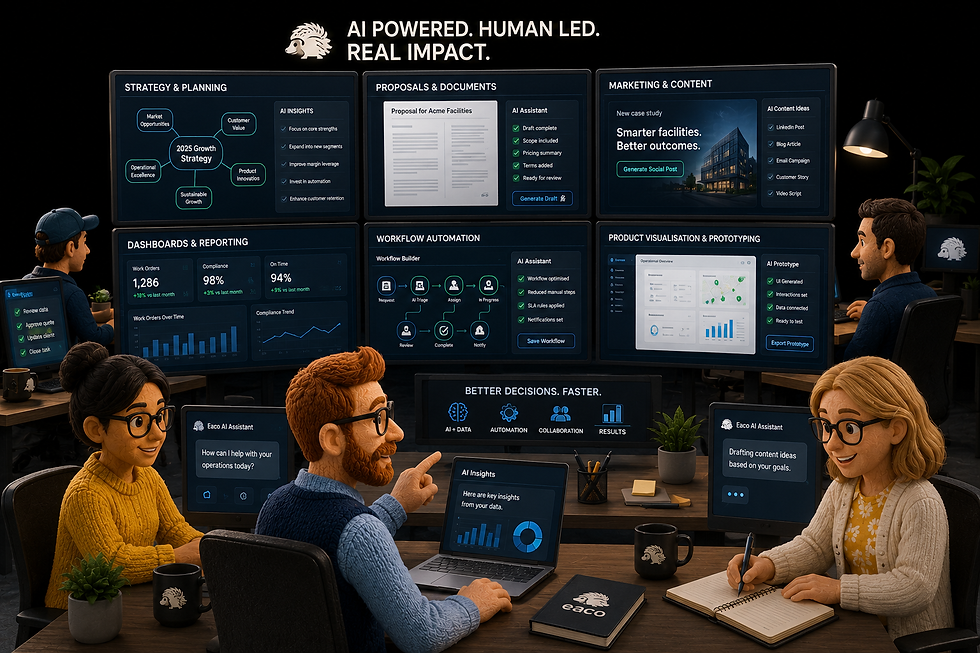
Business planning and strategy has been the standout. Using AI as a sparring partner in a strategy session, something that argues back, stress tests an assumption, and reframes a problem from three angles in the time it takes to make a coffee, has changed how we plan. It does not replace judgement. It compresses the distance between a vague idea and a decision you can actually pressure test.
Marketing content is the obvious one, and it delivers. Visuals, short videos, blog posts, and LinkedIn copy that used to sit in a queue for weeks now move in an afternoon. The trick is treating AI as the first 80 percent and a human as the last 20 percent, because the last 20 percent is where the work either earns trust or quietly loses it.
Presentations, proposals, and contracts have been a major time saver. Structuring a proposal, drafting standard clauses, turning a rough scope into a clean document, this is exactly the kind of high volume, pattern heavy writing where AI shines. With one large caveat we will come back to.
Visualising new product features and building working prototypes has changed how we develop product. We can take an idea, describe it, and have a working prototype in front of the team the same day. Seeing a feature beats arguing about a feature. The conversation moves from "I think it should" to "no, like this," which is a far better conversation to be having.
2. As an Agent doing defined work

The second camp is where it gets interesting for our industry, because this is AI doing operational work rather than just making things.
We have built and used agents for finding relevant tenders, scanning the noise so a human only reviews what is worth reviewing. Agents for creating graphics on demand. Agents that summarise long conversations in Eaco Chat, so the thread you were copied into late becomes a three line catch up instead of a forty message scroll.
Inside Eaco itself, the agents do real platform work. AI List Builders compile lists of job types. AI Form Builders create custom forms from a plain description or an existing document. And AI now helps assemble custom dashboards and portals, so an operator can get the view they need without waiting on a developer.
Notice the pattern in this second camp. Every one of these agents works because it is operating inside a system that already knows what the data means. We will get to why that matters more than anything else.

Where AI has let us down
If the article stopped here it would be marketing, not a white paper. The failures taught us more than the wins, and pretending they do not exist is how operators get hurt.
Proof of delivery is the wall AI cannot climb.

Our entire industry runs on a simple promise: the work was done, and here is the evidence.
AI can fabricate a beautiful image of a finished job. That is precisely the problem. You need real human proof that real work was completed, captured at the site, by a person, at a time, in a place. The moment "evidence" can be generated on demand, it stops being evidence. For FM and cleaning, the value is not in producing images. It is in trusting them.
AI cannot be trusted with the numbers.
In one proposal, an AI calculated a 20 percent discount on $60,000 and confidently arrived at $46,000. We sent it. That single error cost us $2,000. Large language models are pattern machines, not calculators, and they will state an arithmetic mistake with exactly the same confidence as a correct figure. Any number that touches a price, a rate, a margin, or a contract gets checked by a human or run through actual logic. No exceptions.
Agents get slack.
This one surprised us. Agents that started sharp would, over time, quietly do less and less, narrowing what they attempted and skipping the harder parts of the job. Left unattended, an agent drifts toward the easy path. They need re-specification, auditing, and the occasional kick, the same as any process that runs without supervision.
Polished content can be hollow.
AI is very good at producing writing that looks right. Read it closely and a fair amount of it does not actually go anywhere or mean anything. It is fluent and empty. If you are not reading critically, you will ship the emptiness, and your audience will feel it even if they cannot name it.
No single AI is good at everything.
We do not have an AI tool. We have a stack. Different models for coding, content writing, image generation, video, and summaries, and we frequently run the same task through several of them to compare. Anyone selling you one model as the answer to everything has not used them enough to know better.
The thing AI needs more than anything: Context
Here is the pattern that connects every win and every failure above.
Every time AI delivered, it had enough context to work with. Every time it failed, it either lacked the grounding to be accurate, or it was being asked to invent something only the real world can provide. The model was rarely the variable. The context was.
This is the Context Ceiling in practice. The more context you give AI, the better it performs, and it is not a gentle curve. It is the difference between a generic assistant and something that behaves like it actually works for you.
And this is where our industry has a structural problem.

In commercial property services, the context is real, rich, and almost always scattered. It lives in emails, files and folders, spreadsheets, documents, wikis, and CRMs. So ask yourself how an AI is supposed to know:
which buildings you manage
who the key contacts are at each one
what works have already been undertaken there
what works still need to be done
the compliance requirements of that specific site
which workers, employees and contractors both, have been inducted to that site
what skills those workers have, when they are available, and what they cost
The list keeps going. None of that lives in the model. It lives in your business, smeared across a dozen tools that do not share a common language. An AI sitting on top of that mess is brilliant and blind at the same time.
There is a deeper point here that is easy to miss. Context is not just data. It is the relationships between data. The value is not knowing that a building exists, a contractor exists, and a compliance task exists. The value is knowing that this contractor is inducted to that building and is qualified for that compliance task, and is available next Tuesday at this rate. A business is a network, and the useful intelligence lives in the edges, the connections between things, not just the things themselves. AI is only ever as good as the map it is allowed to read. Hand it a pile of disconnected facts and it cannot traverse anything. Hand it a connected picture and it can reason.
That is exactly why we built Eaco as a single platform and a single source of truth. It holds the buildings, the assets, the staff, the clients, the contractors, the compliances, the finances, the works undertaken, the forms required, the files and documents, and the reports, in one connected map. The more clearly we can show the AI what is where, and teach it how to find and do things, the faster and more accurate the results. We are not just storing data. We are drawing the map AI needs to act.
A simple test for your own AI
If you want to know where your business sits against the Context Ceiling, ask which of these your AI could actually do today, without you feeding it everything by hand:
reallocate a set of work orders to a new contractor
give you a compliance status update for a site
summarise all overdue works
offboard an employee and reallocate their works and shifts to someone else
build a list of every overdue compliance task
flag every invoice charging more than the agreed rate

Each of these is trivial when the context is connected and in one place. Each is impossible when it is not. Where your AI lands on this list is a direct readout of how organised your operational data is.
What this means for operators
Pulling the lessons together, here is how we would advise any FM or cleaning operator thinking seriously about AI:
Treat context as an asset. The single highest leverage move is not picking a smarter model. It is consolidating your source of truth so any tool you point at it can actually see your business. Fragmented data is a tax you pay on every future AI capability.
Keep a human on proof and on the numbers. These are the two places AI will hurt you fastest. Evidence of work must be real and human. Anything financial gets verified. Build that as a rule, not a habit.
Match the tool to the task, and keep comparing. There is no single winner. Run a small stack, know what each model is good at, and re-test, because the leaderboard changes constantly.
Supervise your agents. Assume drift. Audit what they are actually doing, not what you set them up to do, and re-specify when they go slack.
Recognise that the systemised operator compounds. A business with its context in one place does not just get better AI results. It is also easier to run, easier to audit, and worth more when it comes time to sell. The work of organising your operation pays off twice.
Where this goes next

The temptation with AI is to chase the model. The lesson we keep relearning is that the model is rarely the constraint. What constrains it is what it can see, what it can trust, and whether the connections between your buildings, people, works, and compliance are written down anywhere it can reach.
The operators who win the next few years will not be the ones with the cleverest prompts. They will be the ones whose business is organised enough for AI to act on it safely. Context is the moat. Everything else is a feature.
We are still experimenting, still comparing models, and still finding new things AI can and cannot do. But the direction is settled. We are not chasing a smarter assistant. We are building a clearer map. Because the clearer the map, the more the AI is worth, and the more the business is worth with it.
Eaco is a single platform for commercial property services that brings buildings, assets, people, works, compliance, and finances into one connected source of truth. Perfect for the world of AI.


