The Contractor Scandal Deepens: Why Signing a Piece of Paper Isn't "Compliance"
How the lawyers got it wrong. Australia's biggest retailers tried to protect themselves with contracts and why that strategy just collapsed.
The (alleged) Scandal You Need to Know About
In early March 2026, 60 Minutes aired an investigation that put some of Australia's most recognisable retail brands in a very uncomfortable position.
The story centred on a large national security and cleaning contractor who, until recently, deployed thousands of workers across major supermarket chains, hardware retailers, discount department stores, logistics warehouses, major sporting events, professional sports clubs, and federal government buildings.
The allegation: the contractor ran a shadow workforce of mostly migrant workers through a network of front companies and corrupt payroll firms. Workers were systematically underpaid. Superannuation was withheld. Penalty rates were ignored. Security guards were reportedly working 60 to 80 hours a week, far beyond what their student visas permitted — leaving them too scared of deportation to speak up.
The company collapsed on Christmas Eve 2024. Its founder left Australia. A multi-agency investigation is now probing what investigators believe to be up to $100 million in stolen wages and evaded taxes dating back to 2015.
The Fair Work Ombudsman has opened inquiries into several major retail clients. Regulators in multiple states have made contact. Politicians have publicly described at least one of the retailers as "morally deficient."
It is, by any measure, a serious scandal.
But Here's the Part That Really Matters
The major retailers didn't just stumble into this blindly. They did what every large corporation does when it outsources services: they made the contractor sign a contract.
That contract almost certainly contained clauses requiring compliance with all relevant employment laws, award wages, visa requirements, proper licences, and appropriate insurance. The contract probably required the contractor to ensure their subcontractors did the same.
In other words, on paper, everything looked fine.
And for years, that was enough. Large companies have operated on the assumption that if a supplier signs a compliance clause, the legal and reputational risk transfers to them. If something goes wrong, the client can point to the contract and say: they agreed to be compliant. We asked. We had it in writing.
This scandal is the moment that assumption died.
Why "We Had a Contract" No Longer Works
There are two reasons the "we had a signed contract" defence is falling apart — one legal, one practical.
Legally, Australian regulators are no longer accepting ignorance as a shield. The Labour Hire Authority boss described Coles' position as an "abuse" of the system, arguing that at the contracted price, Coles had enough information to anticipate that underpayment was occurring. The Fair Work Ombudsman's decision to open preliminary inquiries into the major retailers — not just MA Services — signals a clear shift: if you benefit from a contract that couldn't mathematically deliver compliant employment, you share responsibility for the outcome.
Practically, a signed compliance clause tells you absolutely nothing about what is actually happening. MA Services signed whatever it needed to sign. Beneath the signature, it ran a three-tier shadow workforce that its clients had zero visibility into. The workers didn't appear on any roster the clients could see. The alleged subcontractors (such as Auswide Management Solutions, RMK Management Services, LSS) were invisible. The alleged payroll fraud was invisible.
The contract was a front. And the clients, by relying on it as their primary safeguard, were looking at the front and nothing else.
The New Standard: Proof, Not Promises
The shift that is now underway, accelerated dramatically by this scandal, is from compliance-by-declaration to compliance-by-evidence.
The difference matters enormously.
Compliance-by-declaration is a supplier ticking boxes and signing forms. It says: we attest that our workers are properly paid, licensed, insured, and verified. You take their word for it. If they're lying, you find out on 60 Minutes.
Compliance-by-evidence is something different entirely. It means you have the actual documentation (the licences, the training records, the insurance certificates, the police checks, the right-to-work verifications) sitting in a system that you control, updated in real time, for every single worker your contractor deploys. Not the company. The individual workers.
It means that when a subcontractor's subcontractor sends someone to work in your building at midnight, you know — before that person starts the shift — whether they are who they say they are, whether their work rights are valid, and whether every piece of required compliance documentation is current.
A signed contract cannot give you that. Only a live system can.
What Eaco's Platform Actually Does
This is the problem Eaco was built to solve. Specifically for the facilities management world, where hybrid workforces of direct employees, contractors, and sub-of-subcontractors are the norm rather than the exception.
Eaco's Contractor Management Platform gives organisations real-time, documentary proof of compliance across their entire workforce, every layer of it.
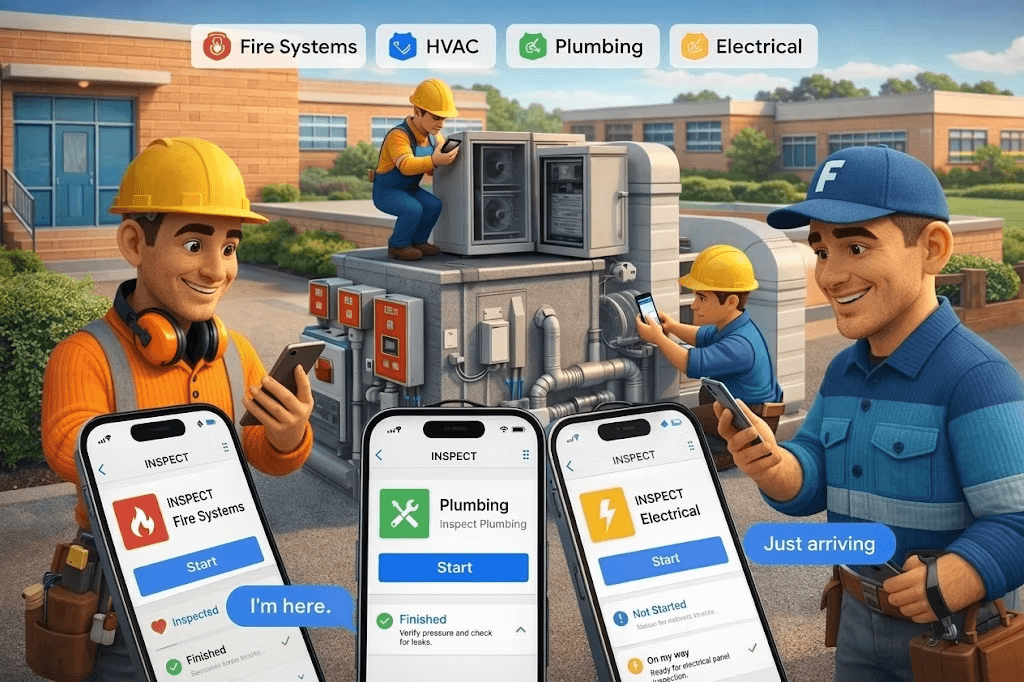
Every worker in the chain (regardless of which entity employs them) has their training records, licences, certifications, insurance, police checks, contracts, and right-to-work documentation captured and maintained in the platform. Compliance isn't verified once at onboarding and forgotten. It's a continuous live status.
Work orders and shifts can only be allocated to workers who are currently compliant. If a licence lapses, if an insurance policy expires, if a police check runs out, that worker is automatically locked out of shift allocation until the gap is resolved. Compliance becomes a gate, not a retrospective audit.
When a worker arrives on site, their identity is verified at the point of check-in. The system confirms that the person presenting is the person who was allocated the work. Ghost workers and substitution (allegedly key mechanisms in the MA Services model) cannot happen undetected.
And critically, the visibility extends down through every tier of the supply chain. The subcontractors of subcontractors that the major retailers had no sight of? In Eaco, they're not invisible. Their workers are in the system. Their compliance is tracked. Their documentation is on record.
This is the difference between having a contract that says your supply chain is compliant and being able to prove (with timestamped, documented evidence) that it actually is.
The Era of Plausible Deniability Is Over
For decades, large organisations have managed contractor compliance the same way: require a signature, file the paperwork, and assume that any wrongdoing further down the chain is someone else's problem.
That model has always been morally weak. It is now also legally fragile.
Australian regulators are sharpening their appetite for holding clients accountable, not just the contractors who do the direct wrongdoing. Modern slavery legislation, tightening labour hire frameworks, and the scrutiny triggered by this investigation all point in the same direction: if you profit from a supply chain, you are responsible for understanding it.
The phrase "we had it in writing" isn't a defence anymore. It's a liability, because it signals that you knew the risk existed and chose the cheapest possible safeguard.
This scandal is not ultimately a story about one bad contractor. It's a story about an industry-wide dependence on paper-based compliance that was always one investigation away from collapse.
That investigation just aired. The question now is which organisations will respond by building real visibility into their supply chains — and which ones will wait to be the next headline.
Eaco's Contractor Management Platform gives facility managers and enterprise clients documentary proof of compliance across their full hybrid workforce — employees, contractors, and sub-of-subcontractors.
Visit eaco.me to learn more.