Should You Sell Your Business Right Now?
The new CGT regime is a real tax hit for serious operators. The harder question is whether anyone will pay you a real price before the rush.

The Budget on 12 May rewrote the capital gains tax rulebook for the first time in a generation, and the WhatsApp groups of every commercial cleaning, FM and trade services operator I know lit up the same evening. The question on the table: do I need to get out before July 2027 or the government takes a bigger slice?
For most operators of any real scale, the honest answer is: yes, the regime change costs you, and it costs you more than the headlines suggest. Whether you should actually pull the trigger is a different question, and a harder one.
What actually changed
From 1 July 2027:
- The 50% CGT discount is gone. It's replaced with inflation indexation plus a 30% minimum tax on the real (above-inflation) portion of the gain.
- Anything you sell before that date sits under the old rules.
- Assets you already hold get a hybrid: the old 50% discount applies up to the asset's value at 1 July 2027 (set by valuation or an ATO growth-rate formula), and the new regime applies to all gain above that point.
- Pre-CGT assets (held since before 20 September 1985) lose their full exemption for gains after 1 July 2027.
Then on 1 July 2028, a 30% minimum tax lands on the taxable income of discretionary trusts. That's not the sale event. That's the annual income trickle out of the trust most CPS businesses sit inside.
The "small business concessions will save us" line: don't fall for it
Plenty of advisers are pointing out that the four small business CGT concessions weren't touched. Technically true. Practically, irrelevant for most readers of this post.
The basic conditions for those concessions cap out at $2M aggregated turnover or $6M net assets. A serious commercial cleaning, FM or trades business does not look like that. By the time you've got depots, fleet, equipment, work in progress, multi-year contracts and any goodwill worth talking about, you're well outside the gate. The 15-year exemption that wipes the CGT bill entirely? It assumes you got in under the cap in the first place.
So when you read pieces saying "calm down, the small business concessions are intact", that's reassurance written for sole traders and micro-businesses. If your CPS operation is doing $5M, $20M or $50M in revenue, you're not in that pool. You're in the pool the change was designed for.
The bit nobody's modelled yet: trusts
Most CPS businesses I work with are held in some flavour of family or discretionary trust structure, not for clever tax planning, but for asset protection and intergenerational reasons that pre-date everyone in the room.
From 1 July 2028, those trusts pay a 30% minimum tax on taxable income before it distributes. The downstream beneficiaries get non-refundable credits, so for high-income beneficiaries it's neutral-ish. For lower-income spouses, kids in education, or any beneficiary on a marginal rate under 30%, the trickle gets more expensive. The income-smoothing flexibility that's been quietly underpinning a lot of business owner cash-flow management for decades just got narrower.
There's three years of rollover relief from 1 July 2027 if you want to restructure out of a discretionary trust into a company or fixed trust. That window is going to be busy. Your accountant is going to be busy. Book early.
Doing the maths: three operators, three outcomes
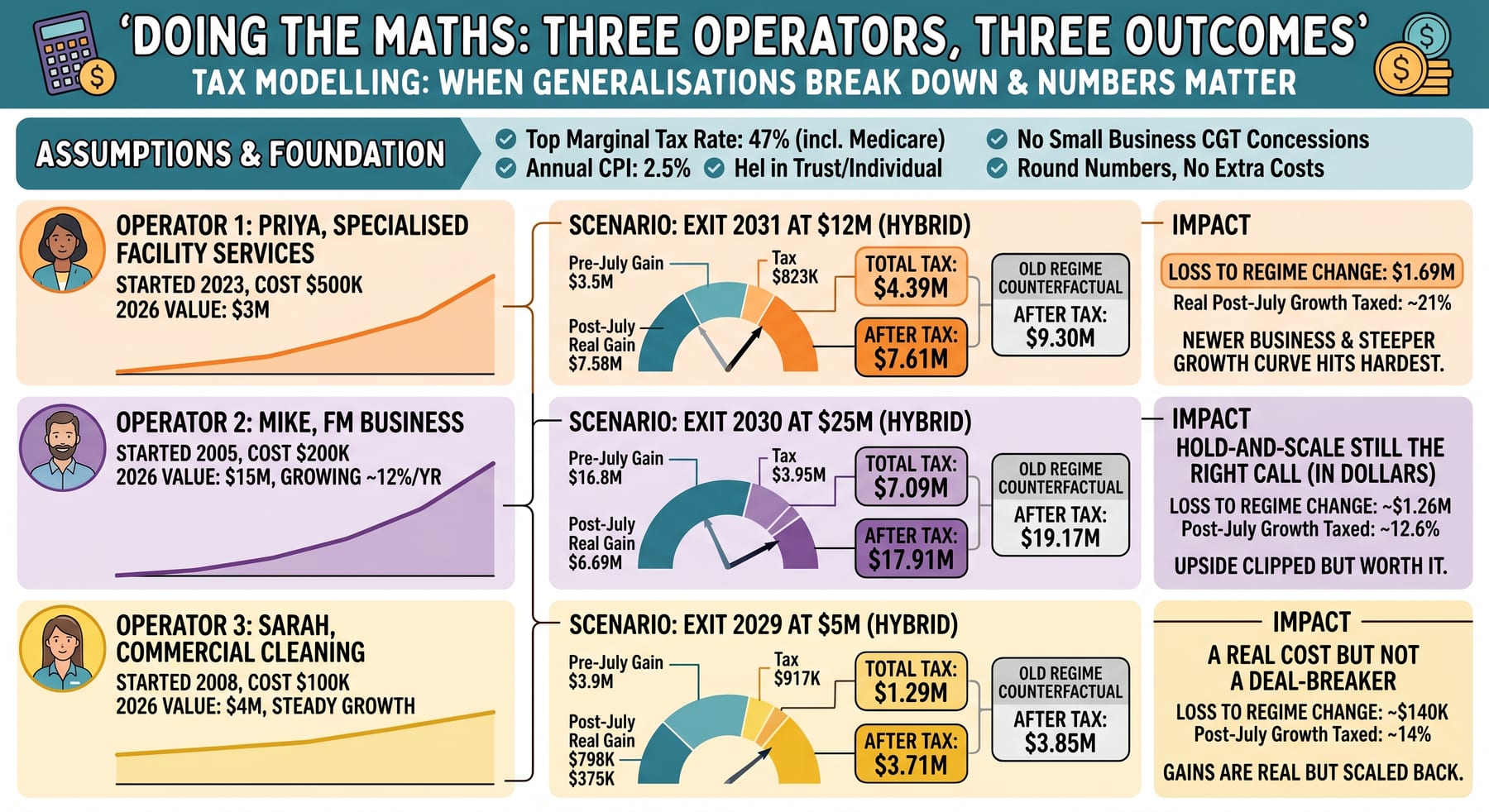
Tax modelling is the point at which generalisations break down and the numbers start to matter. The examples below assume top marginal tax rate (47% including Medicare), 2.5% annual CPI for indexation, the business held in a structure that historically qualified for the 50% discount (individual or trust, not company), and no small business CGT concessions available. Round numbers, no stamp duty, no transaction costs, no franking credits. Treat them as orientation, not advice.
Operator 1: Priya, specialised facility services, started 2023
Started with $500K. Business valued at $3M in 2026, growing fast. Plans to scale and exit in 2031 at a projected $12M.
Sells 2031 at $12M (hybrid, value at 1 July 2027 set at $4M):
- Pre-July portion ($500K to $4M): gain $3.5M, 50% discount, tax $823K
- Post-July portion ($4M to $12M over 4 years): indexed cost $4.42M, real gain $7.58M, tax $3.56M
- Total tax: $4.39M
- After tax: $7.61M
Same 2031 sale modelled under the old regime (counterfactual):
- Gain $11.5M, 50% discount, tax $2.70M, after tax $9.30M
Priya loses $1.69M to the regime change. Because most of her gain falls after 1 July 2027, the new regime captures most of the upside. Around 21% of her post-July real growth disappears to tax that wouldn't have applied under the old rules. The newer the business and the steeper the growth curve, the harder this hits.
Operator 2: Mike, FM business, started 2005
Started with $200K. Built slowly, then scaled. Business valued at $15M in 2026, growing roughly 12% a year.
Sells late 2026 at $15M (pre-July 2027):
- Gain: $14.8M
- 50% discount: $7.4M assessable
- Tax: $3.48M
- After tax: $11.52M
Sells 2030 at $25M (hybrid, value at 1 July 2027 set at $17M):
- Pre-July portion ($200K to $17M): gain $16.8M, 50% discount, tax $3.95M
- Post-July portion ($17M to $25M over 3 years): indexed cost $18.31M, real gain $6.69M, tax $3.14M
- Total tax: $7.09M
- After tax: $17.91M
Same 2030 sale modelled under the old regime (counterfactual):
- Gain $24.8M, 50% discount, tax $5.83M, after tax $19.17M
Mike comes out $6.4M ahead by holding and growing. The new regime takes about $1.26M (around 12.6%) of the post-July 2027 growth that the old regime would have left alone. Hold-and-scale is still the right call in absolute dollars, but a meaningful slice of the upside has been clipped.
Operator 3: Sarah, commercial cleaning, started 2008
Started with $100K of her own capital. Business valued at $4M in 2026. Steady, profitable, growing slowly.
Sells late 2026 at $4M (pre-July 2027, old regime):
- Gain: $3.9M
- 50% discount: $1.95M assessable
- Tax: $917K
- After tax: $3.08M
Sells mid-2029 at $5M (hybrid, value at 1 July 2027 set at $4M):
- Pre-July portion (cost base to $4M): gain $3.9M, 50% discount, tax $917K
- Post-July portion ($4M to $5M over 2 years): indexed cost $4.20M, real gain $798K, tax $375K
- Total tax: $1.29M
- After tax: $3.71M
Same 2029 sale modelled under the old regime (counterfactual):
- Gain $4.9M, 50% discount, tax $1.15M, after tax $3.85M
Sarah gains $630K by waiting and growing the business by $1M. The new regime takes about $140K (around 14%) of that incremental growth. For an operator past the steep part of the growth curve, the regime change is a real cost but not a deal-breaker.
What the numbers actually say
A few patterns worth pulling out.
The pre-July 2027 portion of every gain is treated the same way as today. The 50% discount survives for the value built up to that date. Selling pre-July doesn't unlock a special deal on what you've already built. It just locks in the old regime on whatever happens next.
The bite scales with growth above the 1 July 2027 valuation. A stable, mature business that sells later at roughly the same value loses very little. A fast-growing business that doubles or triples post-July loses real money. The owner whose best years are still in front of them is the one most exposed to the change.
Holding and growing still wins in absolute dollars in almost every case. The regime change doesn't make selling now magically better. It changes the slope of the return on continued ownership, not its direction.
And none of this includes the trust distribution tax from 1 July 2028. Annual income flowing out of a discretionary trust gets the 30% minimum from that date. Five years of ongoing trust distributions can quietly add up to tax that the sale-event maths above doesn't capture.
The honest read: if your business is past its growth phase and you're heading for retirement anyway, the new regime barely changes your sale-day maths. If your business is mid-growth and you're three to five years from your best exit, the new regime takes a meaningful slice of the upside you're holding for. Model both before you decide.
The coming sellers' squeeze
Here's the part the tax commentary keeps missing: every serious business owner in the country is reading the same Budget papers and doing the same maths right now.
If even a fraction of them act on it, the 12 months before 1 July 2027 will see a wave of mid-market businesses come to market simultaneously. That's a buyer's market by definition. Sophisticated buyers, private equity in particular, know exactly what's coming and will time accordingly. Why pay full price in 2026 when the same deal might walk through the door at a discount in early 2027 from an owner racing the clock?
So the tax saving from selling before the deadline is real. The price compression from everyone trying to do the same thing is also real, and it pushes the other way. The two effects don't cancel out cleanly. They vary by business, sector and buyer pool. But the operator who assumes "sell before July 2027 and pocket the discount" is doing half the maths.
Who's actually buying
Now for the more useful piece of the picture. Buyers do exist, and the 2026 environment isn't as bleak as the loudest commentary suggests:
- Private equity is sitting on historic levels of dry powder and is under real pressure to deploy it.
- Foreign buyers accounted for around 45% of Australian deal value in 2025. Australia is still a relatively stable, English-speaking, lower-FX destination for offshore capital.
- Sub-$50M deals dominate Australian M&A by volume, roughly three-quarters of all transactions over the last decade. That's exactly where mid-market CPS businesses sit.
- Succession-driven activity is rising as the founder generation hits retirement.
What's changed is how buyers buy. Due diligence runs longer and deeper. Earn-outs, minority stakes and staged acquisitions are now standard, not exotic. Buyers are using them to bridge valuation gaps and de-risk owner-dependent businesses. And the single biggest valuation killer in this market is dependence on the founder. If the contracts, the relationships, the operational knowledge and the compliance memory all live in your head, the buyer either discounts heavily or walks.
That's the trap most CPS operators are about to walk into. Twenty-five years of business built on personal relationships, paper sign-off sheets, WhatsApp job allocations and "Carlo shows the new guy on Tuesday." From the inside it's a thriving business. From a buyer's diligence list, it's a job that doesn't transfer.
The honest question
So there are two clocks running. One says sell before July 2027 to lock in the old CGT treatment on gains accrued to that date. The other says the buyer market is patient, picky, and getting more selective as the sellers' rush builds.
The right question isn't "should I sell now?" It's:
"Is my business in a state where a serious buyer would pay a serious number for it, and can I get it there in the time I've got?"
If yes, and you're tax-motivated, start the conversation now. A quality process takes 9 to 12 months, and the field gets crowded fast in the second half of 2026.
If no, the CGT timer is the wrong thing to be staring at. A 30% tax saving on a price 40% below what the business should be worth is not the win it looks like. The work between now and July 2027 isn't the sale process. It's making the business worth selling at all.
What "sellable" actually means
The buyer's checklist in 2026 is almost entirely about transferability:
- Are the customer relationships documented, contracted, and held by the business, not by you?
- Are operational SOPs, compliance records, and training materials accessible to a new operator from day one?
- Are jobs, communications, and records all in one place, not scattered across email, WhatsApp, paper, and three different apps?
- Can someone other than you actually run a Monday morning without you being in the room?
This is the work. It's the work most CPS owners have been deferring because the business pays them well enough not to bother. The new CGT regime just put a deadline on the deferral.
The Eaco view
Everything Eaco does, from Chat and Forms and Courses to the live job graph that runs across your network of clients, contractors and assets, is the answer to the buyer's transferability question. Not because we set out to build an exit-readiness platform, but because the things that make a business operate well are the same things that make it sell well: documented work, in one place, accessible to anyone with the right access, with the founder's head not acting as a single point of failure.

Eaco Chat - Connect & Communicate
The messaging network built for commercial property services. Connect your team, contractors and clients in one place. Free for every contractor in your network.

Eaco Compliance, Forms & Reports
The messaging network built for commercial property services. Connect your team, contractors and clients in one place. Free for every contractor in your network.

Eaco Collaboration & Business Management
Run your entire operation from one place. Works management, scheduling, asset registers, invoicing, client portals and real-time reporting. Everything connected, nothing missed.
If you're thinking about selling before July 2027, the most valuable 14 months you have aren't going to be spent on the sale. They're going to be spent making the business worth selling, before the rest of the market is in the queue beside you.
Talk to your tax adviser this month. Talk to a corporate advisor next. And in the meantime, get your business operations out of your head and into a system that survives the handover.
Book a demo or start a free trial.
This is general commentary, not tax or legal advice. Your specific situation will turn on entity structure, asset history and how a transaction is ultimately put together. Get advice that's actually yours.