
Luck as a Strategy (LAAS)
How Systematic Experimentation Manufactures Serendipity
There's a line founders love to throw around: "I don't believe in luck."
I was listening to the Tribe Ventures Podcast the other day, a great way to stay up to date on the Australian tech scene without having to read AFR, Startup Daily, Capital Brief, etc. Don McKenzie chatting away and he mentioned a founder who swears blind that luck plays no part in anything.
I get it. It sounds noble. Stoic. Disciplined.
But honestly? I think that's rubbish.
I've lived the opposite. I've seen luck (real, measurable luck) move mountains. But here's the twist: luck only works when you treat it as a strategy, not a superstition. And the science increasingly backs this up.
The Orange Button That Changed Everything
Back in the Service Central days, I learned the hard way that the universe has a wicked sense of humour.
I was so sure a green "Post a Job" button would convert better than an orange one. Green means go, right? It's universal. Scientific. Rational. All that jazz.
Nope.
Orange crushed it. And from that moment, the orange button became the icon of the business. That tiny change helped channel more than $2 billion worth of work into the hands of Aussie tradies.
That's the day I realised something big: you don't get lucky by guessing right. You get lucky by testing relentlessly.
We started running experiments like madmen. We treated every new test as a raffle ticket. The more tickets we had, the more chances we had to get lucky. And when a winner finally showed up? We doubled down until the wheels rattled.
The Science of Manufactured Serendipity
Years later, I read The Black Swan by Nassim Nicholas Taleb, and suddenly, my instincts had a framework.
Taleb made a fortune in the markets not by trying to predict the future, but by stacking the odds in favour of rare, lucky events. He didn't try to be right all the time. He designed systems so that when luck struck, the upside was enormous—what he calls "positive asymmetry."
His "barbell strategy" is elegantly simple: protect your downside ruthlessly, then take aggressive swings on the upside. Park 90% in safety, and let the remaining 10% chase moonshots. The maximum you can lose is capped; the maximum you can win is unlimited.
Taleb literally engineered his life so he could be hit by positive randomness. That was the penny-drop moment for me. Service Central wasn't magic. It was a machine for creating lucky moments.
The Research Agrees
Psychologists studying serendipity have quantified what intuition tells us. Research by Kevin Dunbar and colleagues suggests that between 30% and 50% of all scientific discoveries are accidental in some sense—but crucially, these accidents only become discoveries in prepared minds.
Louis Pasteur's famous line rings true: "Chance favours only the prepared mind." But preparation isn't passive—it's about creating the conditions where accidents can become opportunities.
Tech entrepreneur Jason Roberts formalised this as "Luck Surface Area"—the idea that your luck is directly proportional to the degree to which you do something you're passionate about combined with the number of people to whom this is communicated. It's a simple formula: Luck = Doing × Telling.
Dr Christian Busch, who researches serendipity at USC and NYU, puts it this way: "Serendipity is the intersection between the unexpected and our own agency." Lucky people don't just notice coincidences—they act on them. Every small action expands the surface area where good things can land.
The Experimentation Arms Race
The world's most successful companies have weaponised this insight. They don't hope for luck. They manufacture it on an industrial scale.
Consider the numbers: Google runs 7,000+ experiments per year. Amazon runs nearly 2,000. Netflix has 300 people dedicated solely to experimentation, with an annual investment of $150 million that yields an estimated $500 million in value. Microsoft's Bing runs over 200 concurrent experiments on any given day.
And here's what's striking: less than 50% of these experiments succeed. Even at the world's most innovative companies, most tests fail. Amazon's failures cost them billions—but Jeff Bezos dismisses this as "the cost of innovation."
As Bezos puts it: "Our success at Amazon is a function of how many experiments we do per year, per month, per week, per day... If you know in advance that it's going to work, it's not an experiment."
The results speak for themselves. A single A/B test at Microsoft Bing—changing how ad headlines were displayed—added $100 million in annual revenue. One test. Twelve per cent revenue growth. A change so minor it had been shelved for months as "low priority" until someone finally ran the experiment.
Google famously tested 41 shades of blue for link text. The winning shade—a slightly more purplish blue—generated $200 million in additional annual ad revenue. These companies aren't getting lucky. They're systematically exploring possibility space until luck finds them.
What This Means for Eaco
This is where things get exciting, because Eaco is built on this philosophy, baked into its bones. How do we deliberately manufacture luck?
Assemble the best tech team on the planet.
Luck favours the team that can ship fast, fix fast, and dream big. Speed is the multiplier on experiments.
Build the best product on the planet.
An extraordinary product is a magnet for unexpected wins—referrals, partnerships, category jumps, the works. Quality compounds.
Release lots of features.
We don't pretend to know which features will explode. We ship, test, measure, and amplify the outliers. Each feature is a raffle ticket.
Meet as many people as humanly possible.
Every conversation with operators, business owners, facility managers, and cleaners is a ticket in the draw. This is Luck Surface Area in action.
Experiment with AI like maniacs.
We build small agents, big agents, dangerous prototypes, things that shouldn't work but might because the one that does work will reshape the industry.
Say yes to opportunity.
Events, partnerships, introductions, chance meetings—we chase the surface area where good things happen.
Keep showing up.
This is the part most people miss. Luck doesn't strike parked cars.
Luck Isn't Lightning. It's Rainfall
Most people think luck is lightning: unpredictable, unrepeatable, striking at random.
Luck is rainfall. If you plant enough fields, dig the irrigation channels, and stay out there long enough, the rain eventually comes. The farmer who plants one field might starve. The farmer who plants a hundred will harvest something.
And this is why that old poster I had in first-year law school still rings true:
A worn-out baseball with the line: "The harder I work, the luckier I get."
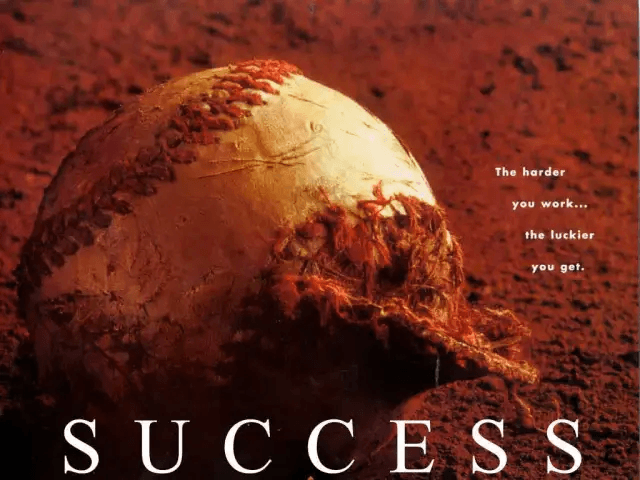
(Often attributed to Hollywood pioneer Samuel Goldwyn, though golfer Gary Player famously put it as "The more I practice, the luckier I get.")
It's not motivational fluff. It's a formula: Luck = (Experiments × Time × Asymmetric Upside) / Downside Risk.
Eaco is one enormous field. And we're out here planting like our lives depend on it.
Because somewhere out there is our next orange button, our next $2B moment, and we're giving ourselves every damn chance to find it.
*
The founders who say they don't believe in luck are half right, luck as a mysterious force blessing chosen ones doesn't exist. But luck as an emergent property of systematic experimentation, relentless execution, and asymmetric positioning? That's not belief. That's engineering.
The question isn't whether you believe in luck. The question is: how many experiments are you running?
What does Eaco do? Who do we Serve?
Eaco is a central platform that keeps the Commercial Property Services sector running smoothly. We believe managing and maintaining commercial properties shouldn’t feel like herding cats. We bring jobs, people, and properties together in one system so you can focus on the work that matters.
Eaco provides the software solutions for doers who keep it all moving:
- Asset Managers
- Facility Managers
- Property Managers
- Operations Managers
- Workforce Planners
- Tradespeople
- Cleaners
- Service Providers
- Franchises
- Contractor Managers; And
- Your Trusted Contractors
Secure a Free Trial of Eaco Today
"Try our luck" .... or try your luck.
You'll be pleasantly surprised by the results when you secure a Free Trial with Eaco today: https://www.eaco.me/requestademo