The Great AI Debate --> Is AI in Facility Management actually Useful?
One infographic lit up the Eaco group chat. The Founder said move fast. The CIO said fix the foundations first. Here's every word of the argument ..... and why it matters for every FM business.
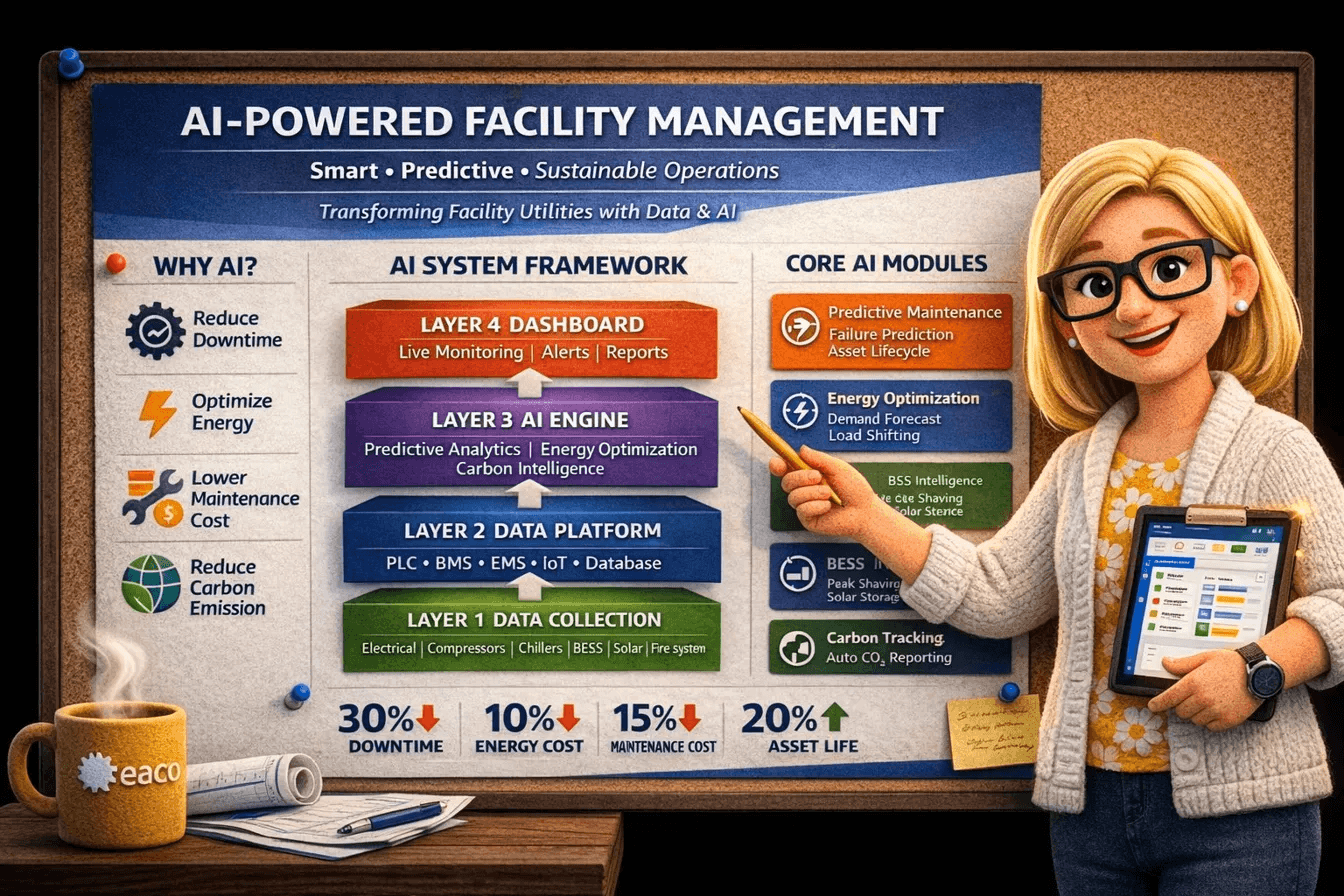
It began, as most good arguments do, with someone sharing something enthusiastically into a group chat. Dan, Founder of Eaco, posted an infographic — a four-layer AI stack promising to transform facility management. Smart. Predictive. Sustainable. Downtime reduced 30%. Energy costs cut 10%. Asset life extended 20%. The kind of slide deck diagram that makes a boardroom nod along.
Mo, Eaco's CIO, read it. Waited 51 minutes. Then responded with two words and a punctuation mark that carries more weight in FM circles than most white papers: "If only!"
The image that kicked off the big debate ....
What followed was one of the more honest conversations we've had inside Eaco — two people who know this industry in forensic detail pulling an idea apart, not to kill it, but to find out what's actually real. Dan pushed the vision of what AI can do for FM businesses right now, today, as a competitive weapon. Mo pushed back on the mechanics of why most "AI in FM" talk collapses the moment it meets an actual commercial building with actual data.
Both arguments are strong. Both are right about different things. And if you run a cleaning company, a facilities management operation, or a commercial property services business — this debate is going to look very familiar.
What the Infographic Actually Claims
The image that triggered the debate is the kind of diagram that circulates regularly in FM and PropTech circles. A four-layer stack: raw data collection at the base (sensors, BMS, IoT, fire systems), a data platform above it, then an "AI Engine" in Layer 3 (predictive analytics, energy optimisation, carbon intelligence), and a live dashboard at the top.
The promised outcomes sit at the bottom of the diagram: 30% less downtime, 10% lower energy costs, 15% lower maintenance costs, 20% longer asset life. Numbers that would transform the economics of any commercial property portfolio.
If it sounds almost too good to be true — well, that's exactly what Mo thought.
The Debate — In Their Own Words
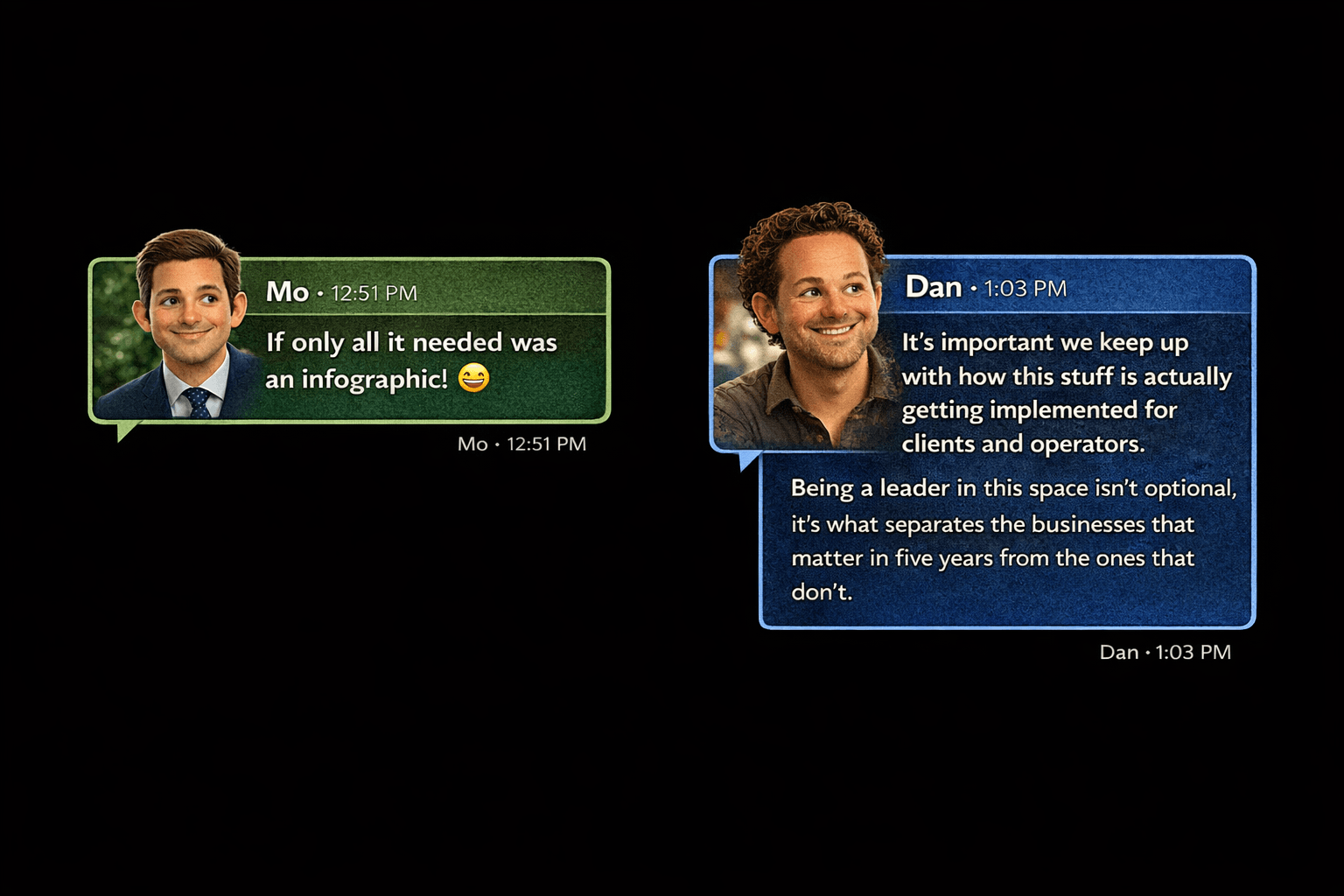
Then Mo went into essay mode .... and honestly, it's worth reading in detail..
His first target was the data problem that sits underneath every AI promise in FM. Not the technology. The inputs.
He opened with condition assessments. Picture two experienced technicians walking through the same office tower, twelve months apart. One rates the rooftop HVAC 6/10 — "fair condition, monitor closely." The other rates the exact same unit 7/10 — "good condition, next service in 18 months." Same asset. Different assessors, different training, different reference points, different days. The Asset Management Plan those numbers feed into is now compromised. The capital planning built on top of that is built on sand. And the AI engine running predictive maintenance off that data? Garbage in, garbage out — with a polished dashboard on top.
Then he went after maintenance logs. Ask a facility manager to pull the full service history for a 15-year-old commercial HVAC system. What arrives is: a PDF of a handwritten report from 2019, a WhatsApp thread with the contractor from last winter, an invoice that says "as per scope" without specifying what the scope actually was, and a note in a spreadsheet nobody has opened since the previous FM left the job. That's not a problem Layer 3 analytics fixes. That's a problem that has to be fixed before Layer 3 is worth deploying.
His sharpest observation, though, was about replace-versus-repair decisions — and it had nothing to do with the technology at all. "Spend $150k on a new HVAC now to avoid $300k in failures and inefficiency over five years" is not a complex calculation. It's a straightforward NPV analysis that competent facility managers have been running on spreadsheets for thirty years. AI isn't needed to produce that recommendation. What AI does — and this is the uncomfortable part — is give the FM political cover to act on it. "AI recommended replacement" is a much safer sentence to put in front of a building owner than "I'm recommending replacement." If the call is wrong, AI was wrong. If it's right, leadership was visionary enough to invest in AI. It's the same reason property companies have paid consultants for decades: not because they didn't know what to do, but because nobody wanted to be the one who said it.
So where does Mo actually think AI belongs in FM right now? Not Layer 3. Layers 1, 2, and 4.
Layer 1 — AI analyses photos of equipment and standardises condition ratings across assessors. It reads handwritten technician notes, extracts the structured data, and updates the asset register automatically. Ten years of unstructured maintenance logs become a clean, searchable service history.
Layer 2 — AI cross-references invoices against work orders. Flags when a job description doesn't match what was charged. Identifies assets that appear in financial records but not in the asset register. Continuous reconciliation of photos, certificates, reports, and database records — the data hygiene work nobody has the time or appetite to do manually, running in the background, permanently.
Layer 4 — AI takes the outputs of the logic layer and makes it genuinely easy to act on them. Not just a dashboard. An AI that drafts the capital request, summarises the risk, flags the urgency, and tells the facilities manager exactly what to do next.
Layer 3, Mo argues, is already well served by conventional algorithms. Fix what goes in. Help people act on what comes out. Then — and only then — does Layer 3 become worth the investment.
He closed with the scenario that makes his whole argument land. A war breaks out in the Middle East. A genuine AI system doesn't see that as an isolated news event. It maps it against the procurement pipeline: a manufacturer in the affected region supplies the compressor modules inside the HVAC units scheduled for replacement across six sites in twelve months. Lead times are stretching. Freight costs are moving. The system flags it immediately — bring that procurement forward now, while there's still availability and pricing you can live with. No pre-programmed rule catches that. You can't write a rule for every geopolitical disruption. That's AI reasoning across unstructured, cross-domain, real-time information in a way that no spreadsheet or rules engine ever could.
That is the Layer 3 that earns the name. But you cannot get there with dirty asset registers and incomplete job histories.
That's why the sequence matters.
Mo's Argument: The FM Data Problem Is the Real Crisis
Mo's core argument is less a criticism of AI and more a diagnosis of why so many AI deployments in property and facility management disappoint. The technology isn't the problem. The data is.
📋 Asset registers are inconsistently maintained.
Most commercial properties carry assets in their register that no longer exist, are missing assets that have been installed, and have condition ratings assigned by different people using different mental scales. An AI engine trained on this data doesn't produce intelligent recommendations — it produces confidently-stated nonsense.
📄 Service histories are largely unstructured.
The documentation trail for a ten-year-old piece of plant equipment typically spans three or four FM platforms, a series of PDF invoices with vague descriptions, email threads, and possibly a paper file. Before AI can reason about a replacement cycle, someone has to structure that history first.
🧑🔧 Job completion data is almost entirely unverified.
In commercial cleaning and routine facility maintenance, the current proof-of-completion workflow is: contractor submits invoice, site manager signs off, accounts pays. There is rarely independent verification of what was actually done, to what standard, at what time. AI cannot optimise a service network whose outputs aren't being measured.
📊 The "AI Engine" in Layer 3 is doing what spreadsheets used to do.
The decision rules that drive predictive maintenance alerts — asset age, service interval, energy consumption trend, historical failure rate — are not complex. They've been expressible in Excel since the 1990s. The packaging is new. The mathematics is not.
Dan's Argument: Move Now. The Window Is Open, Not Permanently.
Dan's counterpoint isn't about the infographic's diagram at all. It's about competitive reality. The FM industry in Australia moves slowly. Technology adoption is cautious. The gap between what's technically possible and what's operationally deployed is enormous — and that gap is where the opportunity lives for the businesses willing to move first.
🗺️ A database of every commercial building in Australia is a genuine competitive moat.
There is no single, accurate, maintained source of truth for commercial properties in this country — who manages them, what services they consume, when their FM contracts are up for renewal. Building that database, using AI to aggregate and continuously update it, is the kind of asset that takes years to replicate. The business that builds it first doesn't just know its clients better — it knows which buildings aren't yet clients and exactly when to approach them.
🤝 Intelligent contractor matching changes the unit economics of FM operations.
Running a subcontractor network across thousands of properties means making dozens of allocation decisions every day. Which contractor has the right trade qualifications? Whose public liability certificates are current? Who performed well on the last three similar jobs? Today, that's a coordinator with a spreadsheet and a lot of institutional memory. AI can do it continuously, at scale, without the single point of failure of one person walking out the door.
📬 AI-powered client communication eliminates the reactive service loop.
Property managers in commercial FM live in a cycle of reactive requests. Something breaks, they call, a quote arrives, they approve it, they chase the contractor, they confirm completion, they process the invoice. Every step is either manual or semi-automated. AI agents can handle 80% of that loop without human intervention — reducing response times and freeing property managers to focus on exceptions.
🛠️ No-code tooling democratises capability across FM businesses.
The services businesses that can build bespoke reporting tools, cost calculators, and client-facing dashboards without expensive development cycles have an enormous advantage. Making it possible for non-technical operators to build these things by describing what they need — rather than specifying how to build it — changes what FM businesses can offer and how fast they can customise their service.
📈 The businesses that train on AI now will deploy the sophisticated stuff first.
Institutional fluency with AI tools takes time to develop. The businesses that start building that capability now, even with imperfect use cases, will be significantly further ahead when genuinely transformative applications arrive. CPD in AI isn't optional for FM leaders. It's a competitive requirement.
Where Does AI Actually Belong? Layer by Layer.
Rather than arguing about whether the infographic is right or wrong, the more useful question is: which layer of the FM stack offers the most genuine value from AI right now?
The Verdict: Where They Agree, and What It Means for You
Strip away the debate framing and Dan and Mo are remarkably aligned. Neither is sceptical about AI's role in FM. Neither is cheerleading uncritically. The disagreement is about where to focus first and how honest to be about what "AI" currently means in this context.
Mo wins the technical argument. His diagnosis of why most "AI-powered FM" deployments underdeliver — the data quality problem at Layers 1 and 2 — is accurate, specific, and consistently overlooked by vendors selling the Layer 3 promise without addressing the prerequisites. Any FM business evaluating AI investment needs to ask itself: is our data clean enough for AI to reason about meaningfully? For most, the honest answer is not yet.
Dan wins the strategic argument. The AI workflows he identifies — building a complete commercial property database, automating contractor matching, compressing the sales and service cycle — are not competing with Mo's argument. They're orthogonal to it. And they represent the kind of compound advantages that determine, over five years, which FM businesses are growing and which are shrinking.
The synthesis: Mo is right about sequence. Dan is right about urgency. Start AI investment where your data is usable and the value is immediate. Build the data foundation in parallel. And stay genuinely curious about what Layer 3 will look like when the data is finally good enough to deserve it.
Which Argument Landed Hardest?
We want to hear from the FM community. Which position is closer to where your business actually is?
- Dan's Corner — Move fast, build the AI surface area across the whole business now, before competitors catch on
- Mo's Corner — Fix the data foundations first. Without that, Layer 3 is theatre
- Both, and in sequence — Start at Layers 1 and 2, build toward 3, and move on growth AI in parallel

Drop your thoughts in the comments, or reach out to the Eaco team directly.
This article was produced by the Eaco team and adapted from an internal debate. Dan is the Founder of Eaco Systems. Mo is the CIO. Both are, despite appearances, on the same side.
NOTE: Mo would like it noted that he is not anti-AI. He would simply like you to clean your asset register before you let AI write capital recommendations based on it.